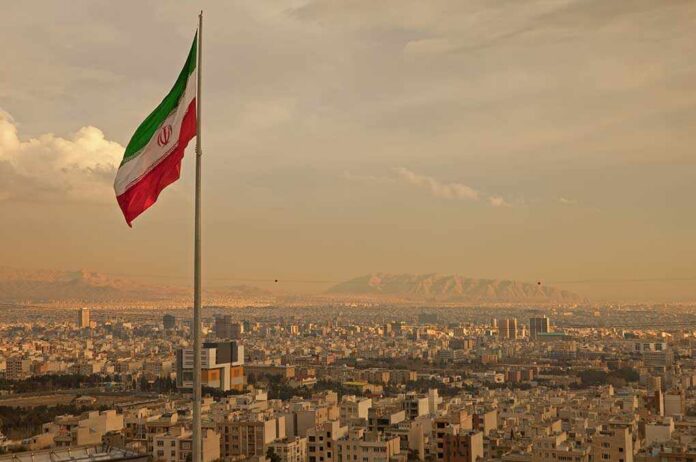
The U.S. military is now warning ordinary Iranians that their own regime is turning neighborhoods into launch pads—putting civilians in the crosshairs to protect the IRGC.
Quick Take
- CENTCOM issued a public warning telling Iranian civilians to stay home as Iran’s forces allegedly launch drones and missiles from populated areas.
- The warning comes during an expanding U.S.-Israel conflict with Iran that began after joint strikes on Feb. 28, 2026.
- Reporting also highlights a separate U.S. internal dispute: the White House paused a homeland-threat bulletin for accuracy and clarity review.
- Gulf infrastructure—including oil facilities, airports, and desalination plants—has been cited as potential targets as the war broadens regionwide.
CENTCOM’s Warning Targets Iran’s Civilian Risk
U.S. Central Command issued a public warning on or around March 8, 2026, aimed not at Tehran’s leadership but at Iranian civilians themselves. CENTCOM accused Iran’s Islamic Revolutionary Guard Corps of launching attack drones and ballistic missiles from densely populated areas, a tactic that increases the likelihood of civilian casualties if strikes occur nearby. The message urged civilians to stay home to reduce risk amid active operations and anticipated responses.
That public-facing approach stands out because it treats information as a form of protection—broadcasting a “get out of harm’s way” warning while signaling that U.S. forces are watching launch activity closely. The underlying claim is straightforward: when a military hides launch sites among apartment blocks and busy streets, it shifts danger onto families who have no control over the regime’s decisions. Independent confirmation of specific launch locations remains limited in the available reporting.
How the Conflict Reached a Direct U.S.-Iran War Footing
The warning lands in the middle of a rapidly escalating war that began after joint U.S.-Israeli strikes on Iran on February 28, 2026. Subsequent bombardments reportedly caused heavy casualties across the region, with deaths reported in Iran and Lebanon and additional fatalities in Israel. Iranian officials, including IRGC-linked messaging through state outlets, have pledged intensified missile strikes against Israel and U.S. assets, increasing pressure on allies and civilians alike.
Analysts cited in coverage describe a familiar pattern in Middle East conflicts: operating from civilian areas to complicate an opponent’s targeting decisions and discourage retaliation. That tactic mirrors what Americans have seen from other Iran-backed or Iran-aligned forces across the region, where blending military infrastructure into civilian terrain increases collateral risk. For a U.S. audience tired of half-measures, the key point is that protecting noncombatants still requires confronting regimes that deliberately erase the line between military and civilian space.
Regional Spillover: Energy, Water, and Evacuations
Events described in current reporting also point to spillover beyond Iran and Israel. Gulf States have been cited as potential targets, including critical infrastructure such as oil depots, airports, and desalination plants—systems that keep economies running and, in the case of desalination, keep people alive. The U.S. has evacuated thousands of Americans via charter flights as the security environment deteriorates, reflecting how quickly this conflict has moved from “over there” to regionwide instability.
Saudi Arabia has reportedly warned Iran against further attacks and threatened retaliation, while the UAE has been described as entering combat operations against Iran. Those steps matter because they suggest Iran’s campaign could generate a coalition-style response, not just bilateral U.S.-Iran exchanges. For Americans watching inflation and energy prices, strikes near oil and shipping routes are not an abstract foreign-policy issue; they can translate into price shocks that hit household budgets back home.
Washington Pauses a Homeland-Threat Bulletin for Accuracy
Separate from CENTCOM’s battlefield warning, reporting indicates the White House halted a DHS/FBI/NCTC bulletin that would have warned of potential Iran-related proxy threats to the U.S. homeland. The stated rationale was review for accuracy and to ensure information is “up-to-date,” and at least one official characterized the draft as poorly written. No U.S. homeland attacks were reported in the referenced coverage, but the pause highlights how much hinges on precise, credible threat communication.
What This Means for Americans Who Want Clear Objectives
The clearest signal from the CENTCOM warning is that the U.S. is publicly framing Iran’s regime as the primary source of danger to Iranian civilians, not merely a rival state trading fire with another military. That framing matters because it reinforces a principle conservatives recognize: regimes that weaponize their own people cannot be trusted to self-limit. At the same time, available reporting cautions that air power alone may not force a regime to collapse, keeping pressure on policymakers to define achievable objectives.
U.S. Now Warning Iranians Their Regime Is Endangering Themhttps://t.co/VdnTW7UzTM
— RedState (@RedState) March 8, 2026
For a Constitution-minded audience wary of endless, undefined foreign entanglements, the practical test will be whether U.S. actions remain tightly tied to clear threats—missile launches, proxy networks, and attacks on civilians and infrastructure—while avoiding mission creep. The available sources describe high-intensity operations, evacuations, and regional risks, but they also show active U.S. messaging aimed at minimizing civilian harm. Limited public detail remains about specific launch sites and verification, underscoring the need for transparent briefings as the conflict evolves.
Sources:
https://understandingwar.org/research/middle-east/iran-update-evening-special-report-march-1-2026/