theredwire.com — Seattle’s Aurora Avenue fight is not really about one block, one night, or even one crime spree; it is about what happens when neighbors decide they trust barricades more than promises.
Quick Take
- Residents near Aurora Avenue say repeated shootings pushed them to block streets and protect homes after a very short burst of gunfire.[1][2]
- Local reporting says police recovered large numbers of shell casings and residents described bullets hitting or nearly hitting homes.[1][2]
- City officials say patrols increased, but neighbors still say the response has not solved the problem.[1]
- The broader case is complicated by Seattle crime data and police claims that some citywide violent-crime measures are improving.
A Neighborhood That Stopped Waiting
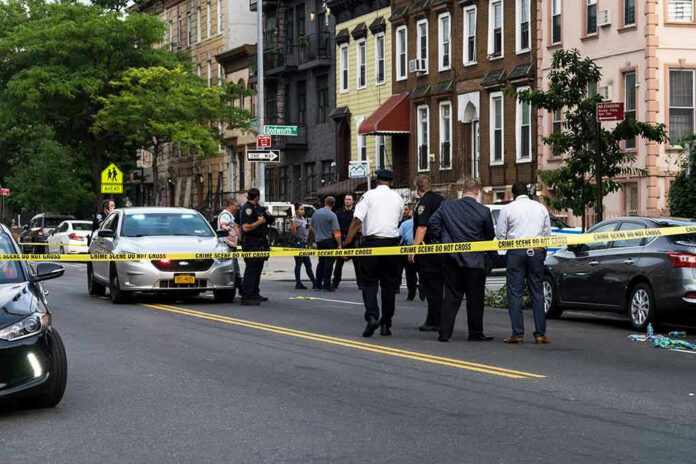
The story began as a safety crisis and quickly turned into a political one. Residents living near Aurora Avenue said they endured a run of shootings so intense that one report described four shootings in 72 hours on the same block, with one incident sending roughly 20 shots into the night.[1][2] That kind of repetition changes a neighborhood’s psychology fast. People stop asking whether violence is real and start asking whether anyone else will act before somebody gets killed.
What made the complaint hard to ignore was the physical evidence. Reporting from the scene described about 40 shell casings after one shooting, and residents said bullets struck homes, damaged cars, and endangered children sleeping inside nearby apartments.[1][2] One man said a bullet hit his fourth-floor apartment while he slept; another said a round hit the wall above his six-week-old baby’s sleeping area.[1] That is the sort of detail that strips away abstraction. This was not an argument about statistics alone.
Why Residents Turned to Barricades
Residents said they had already tried the usual channels. According to the reporting, they contacted the mayor’s office, city council members, and Seattle police, then walked away feeling ignored or underprotected.[1][2] That matters because self-help measures do not emerge from nowhere. They appear when ordinary people decide the system is moving too slowly, or not at all. In this case, neighbors responded with planter boxes, barriers, and street-blocking tactics meant to deter both gunfire and the broader underground activity they associated with the violence.[1][2]
The prostitution-related angle deepens the story. Fox 13 Seattle reported on a broader police operation that freed 26 women from a vast prostitution ring and said investigators traced multiple illicit operations, including sites in the Chinatown-International District.[1] Another Seattle news report on Aurora Avenue described community concerns after a prostitution sting and noted that residents linked ongoing safety problems to shootings, gang activity, and turf wars over the sex trade.[2] The reporting does not prove every shooting was tied to one network, but it does explain why neighbors saw the street as a magnet for recurring danger.[1][2]
Police Response Versus Public Trust
Seattle officials have not said nothing was happening. The mayor’s office said Seattle Police Department patrols increased along Aurora, including late-night and early-morning emphasis patrols, and the city pointed to ongoing enforcement efforts.[1] The problem is trust, not messaging. Once a neighborhood has watched gunfire repeat in the same stretch of road, a claim of “more patrols” may sound like process, not protection. Residents want the simpler evidence of safety: fewer shots, fewer shells, fewer reasons to build walls.
Terrified Seattle neighborhood builds massive barricade across streets amid horrific crime wave https://t.co/FhOKxk9bZ0
— Sanford Tillman (@sgtilltwtr) May 26, 2026
The city also has a broader data argument on its side. Seattle Police maintain a public crime dashboard, and police leadership has said citywide shootings, shots fired, homicides, and violent crime have shown improvement. That does not erase what Aurora residents experienced, but it does complicate the easiest version of the story, which is that police have simply disappeared. The more accurate reading is narrower and more uncomfortable: a citywide trend can improve while one corridor still feels like a live wire.
What This Fight Says About Urban Safety
Community-policing doctrine helps explain why residents do not always wait politely for official rescue. The Office of Justice Programs says community policing treats all members of the community as active allies in safety, not passive recipients of service.[3] That idea sounds clean in a policy paper and messy on a street with fresh shell casings. Still, it explains why neighbors sometimes become the first people to organize, monitor, block, and warn. They are not trying to replace police in theory; they are trying to survive until police feel present in practice.
There is also a more conservative reading here that matches common sense: public order is the first job of government, and when residents start improvising roadblocks, the system has already lost credibility. At the same time, the evidence in this case does not support the claim that neighborhood action itself solved the violence or that Seattle as a whole collapsed into lawlessness.[1] What the record does support is a more limited, more revealing truth: a handful of blocks can become so volatile that ordinary people choose barricades over faith in the next patrol car.
Sources:
[1] Web – Why Is Ballard So Crime-Ridden? | Post Alley
[2] YouTube – Seattle’s Greenwood neighborhood calls growing crime a ‘state of …
[3] Web – [PDF] Understanding Community Policing – Office of Justice Programs
© theredwire.com 2026. All rights reserved.