

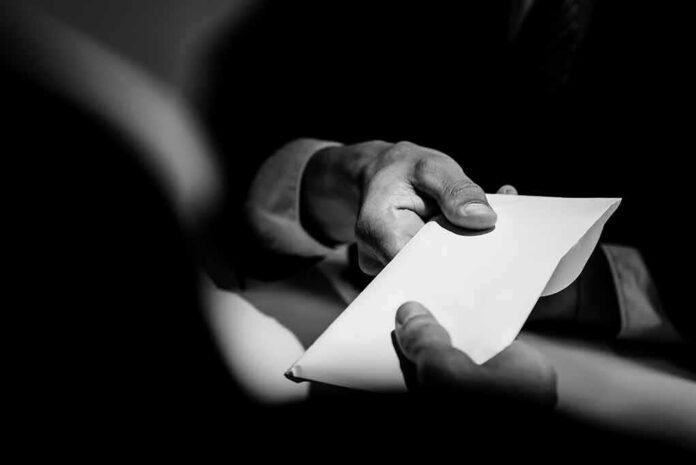
A Quincy, Illinois man is accused of mailing fake anthrax threats to four members of Congress while writing his own name and home address on every envelope.
Quick Take
- Matthew Unglesbee, of Quincy, Illinois, faces federal charges for mailing white powder letters to four congressional offices.
- All four envelopes reportedly carried his real name and address as the return address, matching government records.
- He allegedly told the FBI the substance was table salt, picked because it “kind of looks like anthrax.”
- Agents reportedly found a fifth, unmailed envelope addressed to a Washington, D.C. congressional office at his home.
Four Envelopes, One Return Address
The Department of Justice says Unglesbee mailed plain white envelopes with handwritten addresses to four Illinois congressional offices. Each one reportedly carried a Springfield postmark dated October 19 and held a white granular substance. Investigators say every envelope listed his own name and home address as the sender, directly tying him to the mailings.
Prosecutors charged Unglesbee under federal laws covering hoaxes and threatening communications. The Justice Department’s local office in Illinois announced the arrest and said the case began as a criminal complaint, meaning the allegations still must be proven in court.
‘It Kind of Looks Like Anthrax’
According to the complaint, Unglesbee told FBI agents the powder was ordinary table salt. He reportedly said he chose salt because it resembled anthrax, the deadly bacteria used in the 2001 letter attacks that killed five people. Notes inside the envelopes allegedly read “HAH enjoy the gift” and “HA HA”.
Investigators say Unglesbee understood recipients might not know it was a joke. He reportedly acknowledged staff could treat the letters as a real threat and call in hazmat teams, a response that disrupts congressional offices and diverts emergency resources even when no danger exists.
A search of his home turned up a fifth envelope, already addressed to a congressional office in Washington, D.C., but never mailed, according to court records cited in news reports. Testing on the substance in the mailed letters reportedly confirmed it was salt, not a hazardous material.
Denial on Broader Mailings, Admission on His Own
Unglesbee reportedly denied sending similar white-powder letters that went to other congressional and election offices around the country in recent weeks. He told agents he does not have money to travel to other states, according to court documents cited by local reporters.
Instead, he reportedly said he mailed the Illinois letters after hearing news coverage about those other mailings elsewhere. He called his own letters a joke but admitted recipients would have no way of knowing that, according to the same reporting. That narrow admission matches the broader pattern described by authorities, even as it separates his case from the nationwide wave of similar incidents.
Part of a Recurring Pattern Since 2001
White-powder hoaxes have followed a predictable pattern since the real anthrax attacks of 2001. Public health researchers in Georgia found that officials fielded hundreds of suspicious-powder reports in the years after those attacks, and virtually none involved actual anthrax. Even so, responders had to treat every report seriously because the cost of ignoring a real attack was too high.
An Illinois man allegedly mailed letters filled with white powder to four members of Congress — then put his own return address on every single one.
Matthew G. Unglesbee now faces two felony charges after the FBI says he sent the letters as a fake anthrax hoax, telling law… pic.twitter.com/IYM3rBsO7f
— Fox News Politics (@foxnewspolitics) October 27, 2026
That asymmetry explains why hoax cases like this one still trigger full law enforcement responses and federal charges, even when the substance turns out to be harmless. Congress members and their staff cannot know in the moment whether a white powder is salt or something deadly, so every letter gets the same urgent treatment regardless of intent.
What Happens Next
Unglesbee’s case now moves forward in federal court in the Central District of Illinois. The publicly available account rests on a criminal complaint, not a trial verdict, so the specific charges and evidence will face further scrutiny before any conviction. For now, the episode adds another entry to a long list of mail hoaxes that force federal agencies to spend time and money chasing threats meant, by the sender’s own account, as a prank.
Sources:
wpxi.com, justice.gov, wjla.com, abc7news.com, fox32chicago.com, washingtonsun.com, case.hks.harvard.edu
© theredwire.com 2026. All rights reserved.