A 44-year-old mall security guard lay crushed under seven floors of concrete for eight days, yet walked out as living proof that courage and competence can still beat chaos.
Story Snapshot
- Twin earthquakes collapsed a Venezuelan mall, trapping guard Hernán Alberto Gil Flores deep under the parking structure.
- Rescuers kept him alive for days by talking to him and feeding him water and nutrients through a hose and narrow shaft.
- International teams from Latin America, the United States, and Europe worked side by side to tunnel through deadly wreckage.
- The “miracle rescue” now sits beside hard questions about building safety and the failure of local institutions.
The collapse that buried a working man and exposed a fragile system
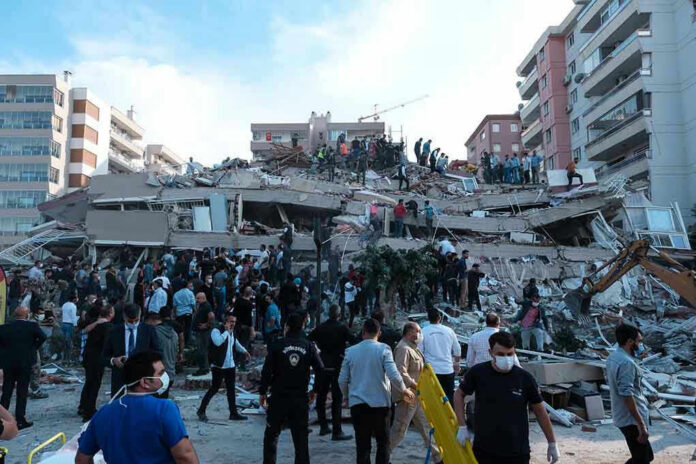
The Galerías Playa Grande shopping center in La Guaira did not fall in slow motion or with warning. Twin earthquakes, with magnitudes reported above seven, hit on June 24 and snapped the structure’s limits in seconds, crushing its basement parking levels into a layered concrete tomb. Hernán Alberto Gil Flores, a night-shift security guard in his small cabin, went from routine work to absolute darkness as seven levels of structure collapsed above him. He was 44 years old, with two children depending on his paycheck and his presence.
What followed shows the split screen that defines much of Latin America today. On one side, local institutions staggered under the scale of the disaster. On the other, foreign rescue teams rushed in with discipline, training, and gear that many Venezuelan crews simply do not have. Crowds outside the ruins begged for more help, more supplies, and faster action, while social media filled with anger at the slow, uneven response by authorities. The mall collapse became not just a tragedy, but a symbol of state weakness in a country already battered by crisis.
The race to reach a voice under seven floors of concrete
Within days, international urban search and rescue teams from Chile, Costa Rica, Mexico, El Salvador, the United States, Portugal, and Venezuela itself converged on the parking structure. A specialized Costa Rican Red Cross team led the early breakthrough: they detected signs of life, established contact, and confirmed a man was still conscious somewhere inside the wreckage. Video and field reports show rescuers threading a telescopic camera into voids in the collapsed basement until they finally saw something small but unmistakable—a human hand responding to their signals.
From that moment, Hernán stopped being a possible victim and became a living patient under their care. Teams pushed a hose and narrow tubing through a shaft to deliver water and liquid nutrients, then later intravenous fluids when access allowed. Salvadoran rescuers reported more than 28 hours of continuous effort at one stage, keeping him talking and hydrated while they fought rain, aftershocks, and a dangerously unstable structure. Chile’s fire brigade later explained that the final rescue tunnel took about 70 hours of work and more than a dozen careful approach maneuvers to avoid causing a fatal secondary collapse.
A miracle rescue backed by hard skill, not just hope
Rescue leaders called the operation a “small miracle,” but the facts show something that lines up more with engineering, discipline, and grit than pure luck. Most disaster teams quietly accept a grim rule of thumb: after 48 to 72 hours, the chances of pulling someone out alive drop to near zero. Hernán beat those odds by a huge margin, surviving about 168 hours under the wreckage before his extraction, because teams never treated him as a body they might find—they treated him as a patient they refused to lose.
Chilean firefighters coordinated the tunnel work, while Costa Rican, Mexican, Salvadoran, United States and local Venezuelan teams rotated through the most dangerous tasks. They used cameras, acoustic devices, and simple conversation to track his condition. They passed food, water, and medicine through a hose and syringe when that was all the space they had. CNN quoted a United Nations disaster coordinator who said that by day seven, only “miraculous rescues” are still possible—and Hernán’s case now sits in that rare category.
Hope on a stretcher, questions in the streets
When crews finally pulled Hernán out on a stretcher, covered in dust but alive, they gave Venezuela the kind of image every shaken nation craves—a living face of hope. Chile’s fire brigade reported he was in “good condition” and transferred to a medical facility, news that was quickly echoed by international outlets. El Salvador’s President Nayib Bukele publicly praised his teams, confirming they had reached Hernán and helped keep him stable during the long operation. For a moment, politics paused; duty took center stage.
Yet the concrete questions remain. Why did a major mall collapse so completely that a guard’s cabin ended up buried under roughly nine stories worth of debris? Why were foreign crews and foreign media the most reliable sources for basic facts about the rescue and Hernán’s condition, while official Venezuelan documentation still lags behind? For many conservative Americans watching from afar, the scene feels familiar: a regular working man pays the highest price when regulators are weak, buildings are not built to modern standards, and government response is slow and politicized.
Sources:
youtube.com, unotv.com, teletica.com, instagram.com, facebook.com, 10news.com, cnn.com, upi.com, abc.net.au
© theredwire.com 2026. All rights reserved.