
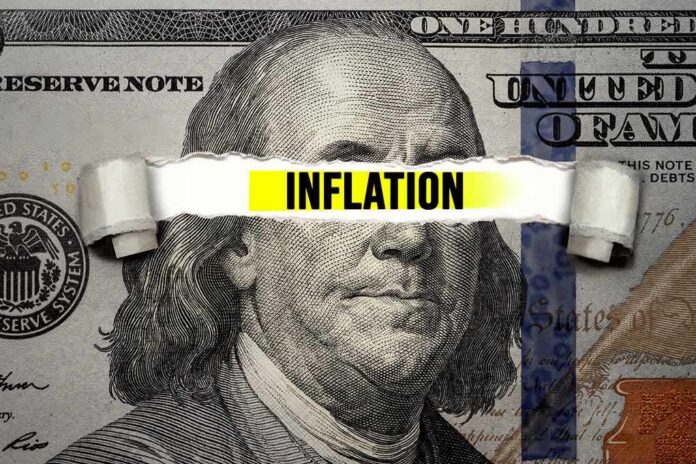
Inflation hitting 4.2% for May signals families are still paying the price for years of bad policy and rising energy costs.
Story Snapshot
- May inflation is expected at 4.2% year over year, a three-year high [1][3].
- Core inflation is forecast near 2.9%, still above the Federal Reserve’s 2% goal [1].
- Energy costs led recent monthly gains, stressing gas and utility bills [7].
- April inflation ran 3.8% year over year, confirming the uptrend [5].
Inflation Jumps To A Three-Year High In May Forecasts
Economists expect the Consumer Price Index to rise 4.2% in May compared with last year, the highest pace in more than three years [1][3]. That marks a clear move up from April’s 3.8% yearly rate reported by the Bureau of Labor Statistics [5]. These numbers say price pressure remains stubborn. Households feel it first at the pump, the grocery store, and when rent comes due. A higher headline rate also shapes markets and raises new questions for interest rates this summer [3][5].
Forecasts point to a 0.5% month-over-month gain in May, driven in part by energy costs, which would lift the year-over-year rate to 4.2% [3]. Analysts flagged gasoline and other energy items as key movers in recent months [3]. When energy jumps, delivery, travel, and home utility costs often follow. That spillover squeezes family budgets fastest. It also complicates planning for small businesses that rely on transport and steady input prices to keep shelves stocked and payrolls stable [3].
Core Inflation Stays Above Target, Signaling Persistence
So-called core inflation, which strips out food and energy, is forecast at about 2.9% year over year in May, above the Federal Reserve’s 2% target [1]. In April, measures that exclude food and energy were still running hot compared with the goal, even as the headline rate climbed [5]. Data tracked by market services showed core running near the high twos into spring 2026 [2]. That gap means price growth is not only an energy story. It shows broader stickiness in services and shelter costs [1][2][5].
Republican members on the Joint Economic Committee highlighted how April’s monthly jump leaned heavily on energy, which rose 3.81% from March to April [7]. Headline inflation rose 0.64% month over month, while food rose 0.50% [7]. That breakdown backs the view that energy shocks lifted the headline rate. Still, core staying near 3% suggests inflation pressure is more than a one-off spike. Families cannot dodge higher rent, insurance, and many services, even if gas prices ease later [1][2][7].
What Sticky Prices Mean For Rates, Markets, And Families
Higher inflation readings make it harder for the Federal Reserve to cut interest rates soon. Analysts looking ahead to May warned that a 4.2% headline rate would keep policy tight for longer [3]. April’s official report already showed a step up from March to April, to 3.8% year over year [5]. Financial markets track these numbers closely because borrowing costs for homes, cars, and small business loans depend on the path of inflation and the Federal Reserve’s next moves [3][5].
Conservative readers know how we got here. Years of overspending, supply shocks, and green mandates pushed energy higher and spread pain through the economy. Recent data echo that story, with energy leading the monthly surge [7]. While some point to energy as “temporary,” families have heard that before. Core inflation near 3% shows sticky forces at work [1][2]. The task now is clear: hold the line on spending, boost U.S. energy, and keep policy focused on stable prices.
How Households Can Read The Next Wave Of Data
Shoppers should watch the headline rate for gas and grocery pressure and the core rate for staying power. If headline remains near 4% and core holds close to 3%, relief may be slow. If energy calms but core stays hot, rent and services will still strain budgets [1][2][3]. April’s 3.8% annual rate proved the uptrend is real, not hype [5]. The April-to-May handoff, with energy in the driver’s seat, will tell us whether this is a crest or a longer grind [3][7].
Sources:
[1] Web – BREAKING: Inflation rises 4.2% annually in May, highest in three years …
[2] Web – Inflation in May likely topped 4% for the first time in 3 years …
[3] Web – United States Core Inflation Rate – Trading Economics
[5] Web – Current U.S. Inflation Rates: 2000-2026
[7] Web – The risk of higher US inflation in 2026 | PIIE
© theredwire.com 2026. All rights reserved.