

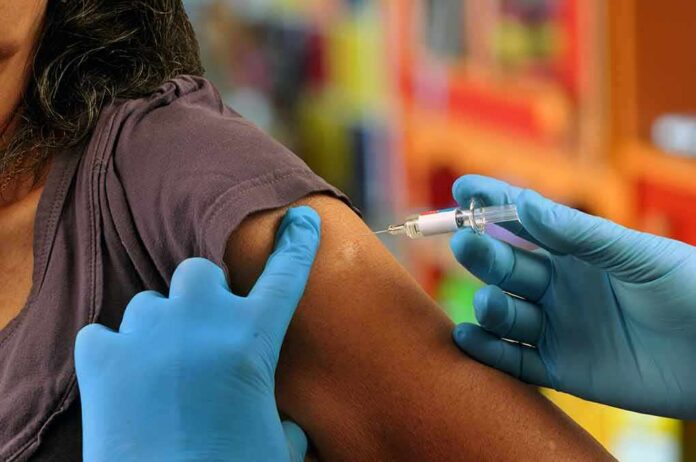
A cancer vaccine built from a patient’s own tumor could be ready in weeks, but the federal rulebook built to approve it was written for drugs that look the same for everyone.
Quick Take
- Personalized cancer vaccines are built from each patient’s own tumor mutations, meaning no two doses are exactly alike.
- Food and Drug Administration (FDA) guidance was designed around conventional, one-formula vaccines, not thousands of unique single-patient batches.
- Federal cancer researchers call decentralized manufacturing capacity, not approval rules, the biggest obstacle to scaling these vaccines nationwide.
- Moderna and Merck’s personalized vaccine won FDA Breakthrough Therapy status, but that status is not approval for public use.
- Early results look promising, but long-term survival data still has not caught up with the hype.
Why A Vaccine Made From Your Own Tumor Breaks The Old Mold
Most vaccines are the same shot for every patient. Personalized cancer vaccines flip that idea. Doctors sequence a patient’s tumor, find its specific mutations, and design a vaccine aimed only at those targets. A company making these vaccines might produce a thousand different formulas for a thousand different patients, each one a tiny, custom-built batch.
That approach shows real promise in early studies. A Phase I trial funded by the National Cancer Institute (NCI) is testing a personalized peptide vaccine for bladder cancer and other solid tumors, built around each patient’s leftover disease after treatment. The goal is not just to see if the vaccine works. It is to see if doctors can even make it reliably for every single patient.
FDA’s Rulebook Was Built For A Different Era Of Medicine
FDA’s main guidance for cancer vaccines lays out a familiar path. Early trials test dose and safety. Later trials prove the vaccine works in a defined group of patients. Everything builds toward one biologics license application covering one standardized product. That system makes sense for a vaccine made the same way every time.
Personalized vaccines do not fit that mold neatly. Manufacturing rules for biologics already demand detailed proof of identity, purity, and consistency for every batch. When every batch is different by design, meeting those standards for each individual patient becomes a much bigger lift than for a single mass-produced product.
Ongoing conversations among regulators and researchers reflect this tension directly. Experts have pointed out how artificial intelligence tools are now helping scientists design these personalized treatments faster than regulatory systems were built to review them, raising real questions about whether oversight can keep pace with the science.
Manufacturing, Not Paperwork, May Be The Real Bottleneck
Federal advisers studying cancer vaccines in 2026 did not point to FDA review delays as the main problem. They pointed to manufacturing. Advisory committee minutes describe decentralized manufacturing capacity for personalized vaccines as the “principal operational challenge” to rolling the technology out nationwide, and propose a hub-and-spoke model with centralized academic labs supporting regional satellite sites.
That same committee noted FDA is already considering ways to ease early-stage requirements, including proposals to simplify the paperwork needed before a trial even begins. That is a meaningful signal. Regulators themselves seem to recognize that some early rules may be heavier than the science actually requires, even if nobody has proven that review delays, specifically, are slowing patients down.
Breakthrough Status Is Real Progress, Not A Finish Line
Moderna and Merck announced in 2023 that FDA granted Breakthrough Therapy Designation to their personalized mRNA vaccine, built around up to 34 mutations unique to each patient’s tumor. That designation fast-tracks FDA’s attention and resources. It does not mean the vaccine is approved, safe for widespread use, or proven to extend lives. Readers should treat it as a milestone, not a verdict.
Separate FDA-regulated trials of personalized mRNA vaccines for cancer rely on a single commercial manufacturer to produce patient-specific doses under strict quality controls. That dependence on one manufacturer highlights just how much infrastructure, not just regulatory approval, still needs to scale before these vaccines reach ordinary patients broadly.
The Honest Caveat Nobody Should Skip
Published regulatory reviews are blunt about where things stand. Biologics approval still requires solid proof of safety and effectiveness, not just promising biology. Independent assessments of personalized cancer vaccines as a category note they lack clear, settled regulatory guidance, which can cause different agencies to reach different conclusions about the same science. Nothing here suggests regulators are standing in the way of a cure. It suggests the rulebook simply has not finished catching up to a genuinely new kind of medicine.
Conservative instincts on this issue should land in a sensible place. Innovation deserves room to move fast, and FDA’s own willingness to streamline early paperwork is a good sign. But loosening the rules that confirm a product actually works and is made safely for every patient is a different matter entirely. Patients deserve speed. They deserve proof even more.
Sources:
reason.com, fda.gov, cancer.gov, clinicaltrials.gov
© theredwire.com 2026. All rights reserved.