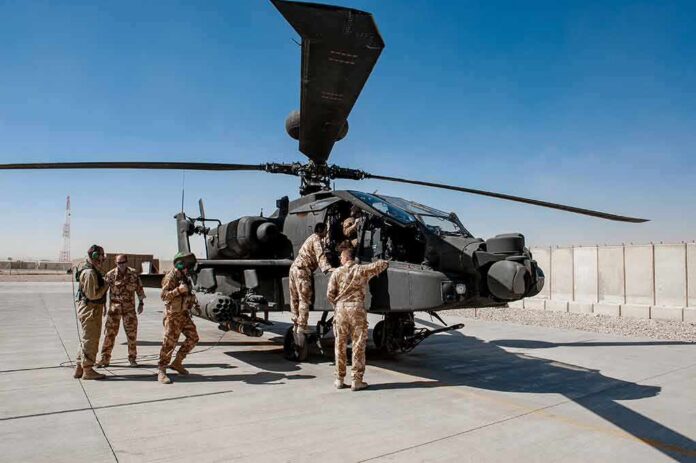
Iran’s latest missile strike that killed two American warriors in Jordan shows a hostile regime testing U.S. resolve and trying to drag more of the region into war.
Story Snapshot
- Iran’s Revolutionary Guard says it fired missiles and drones at a U.S. air base in Jordan, killing two service members and leaving one missing.
- Central Command reports this attack raises the total U.S. combat deaths in the Iran conflict to 16, with many more wounded and bases damaged.
- Iranian commanders openly warn of more strikes on U.S. bases across the Middle East if Washington keeps hitting targets inside Iran.
- Tehran claims the attacks are “retaliation,” yet the pattern of repeated strikes looks like a push to widen the fight and pressure U.S. allies.
Iran’s Strike on U.S. Forces in Jordan
United States Central Command confirmed that two American service members were killed and one remains missing after Iran launched ballistic missiles and drones at Muwaffaq Salti Air Base near Azraq, Jordan. The attack hit a facility used by U.S. forces supporting operations against Iran and its proxies. Central Command said the troops died while defending against the incoming weapons, and four more Americans were evacuated for treatment and later discharged. This single strike added to a growing list of American casualties in the wider Iran conflict.
Iran’s Islamic Revolutionary Guard Corps, which answers directly to the supreme leader, publicly claimed responsibility for striking U.S. aircraft at the Jordan base. In its statement, the Guard boasted that missiles and drones destroyed several refueling aircraft and fighter jets and caused serious damage to other assets. Iranian state outlets described the target as an American “command and control center” and said the strike was part of a larger retaliation campaign for earlier U.S. attacks on Iranian territory. The messaging from Tehran aims to show strength and intimidate regional partners hosting American forces.
A Deadly Pattern of Escalation
This latest attack is not an isolated event but part of a long chain of strikes on U.S. positions since 2023. Iran and Iran-backed militias have carried out more than 170 attacks on American bases in Syria, Iraq, and Jordan during the current Middle East crisis. Earlier in the war, Iran used drones and missiles to hit American and allied facilities across the region, causing an estimated $800 million in damage in just the first two weeks. Each new strike gives Iran leverage, sends a message to U.S. allies, and tests how firmly Washington will stand by its troops and commitments.
Americans still remember the Tower 22 drone attack in northeast Jordan back in January 2024, when an Iran-backed militia killed three U.S. soldiers and wounded dozens more. A Pentagon spokesperson stated at the time, “We know that Iran is behind it,” stressing that Tehran arms and guides these proxy groups. That attack was a turning point because it proved U.S. troops in “support” roles were directly in the line of fire. The new missile strike on Muwaffaq Salti Air Base shows the threat has not faded; it has escalated from proxy drones to open Iranian ballistic missiles.
Is Iran Trying to Widen the War?
Iranian officials insist they are not seeking a wider war, and the foreign ministry often says allied militias act on their own. At the same time, the Revolutionary Guard keeps launching missiles at U.S. bases and openly warning that more locations will be targeted if America continues strikes inside Iran. In this case, Tehran framed the Jordan attack as “punitive” retaliation for U.S. actions, including earlier operations near the Strait of Hormuz. For many observers, the gap between Iran’s words and its violent behavior raises serious doubts about claims that it only wants defense, not expansion of the conflict.
The strike in Jordan also fits a clear pattern of pressure on U.S. partners who host American forces. Iranian commanders have previously warned countries like Jordan, Kuwait, Qatar, and Bahrain that they have a “responsibility” to stop allowing their territory to be used for U.S. operations against Iran. Recent waves of Iranian missiles and drones have targeted bases in several of those nations, including repeated claims of attacks on Azraq Air Base in Jordan. By making these allies feel vulnerable, Tehran tries to peel them away from Washington, limit basing options, and weaken the U.S. ability to protect its interests and its people.
Costs for America and Questions Going Forward
Central Command reports that the death toll for U.S. service members tied to the Iran conflict has now reached at least 16 since late February 2026. That number reflects only the killed; many more have been wounded, and base infrastructure across the region has been damaged or destroyed. For families back home, each new casualty is a painful reminder that Iran’s missiles and drones are not abstract threats. They are aimed at real Americans, serving far from home, who rely on strong leadership and clear rules of engagement to stay alive and complete their missions.
Mike Jernigan on Fox News: Iran is attempting to escalate the conflict following the deadly missile strike in Jordan that killed two American service members
🇺🇸🇮🇷🇯🇴‼️‼️‼️‼️‼️‼️‼️‼️‼️‼️‼️‼️
— WW3 Monitor (@WW3_Monitor) July 18, 2026
The Trump administration has responded with fresh strikes on Iranian targets and vowed to hit the regime “hard” when it attacks American forces. At the same time, U.S. leaders say they do not seek an all-out war, and they face pressure to balance deterrence with restraint. Critics warn that vague red lines and slow responses only invite more Iranian tests. Supporters of a firmer stance argue that decisive action, clear communication to allies, and stronger missile defenses are needed to protect U.S. troops, uphold commitments, and stop Tehran from turning limited clashes into a wider regional blaze.
Sources:
facebook.com, nytimes.com, washingtonpost.com, en.wikipedia.org, ndtv.com, npr.org, rferl.org, fdd.org, theguardian.com, forbes.com, atlanticcouncil.org, youtube.com, theiranpost.com
© theredwire.com 2026. All rights reserved.