
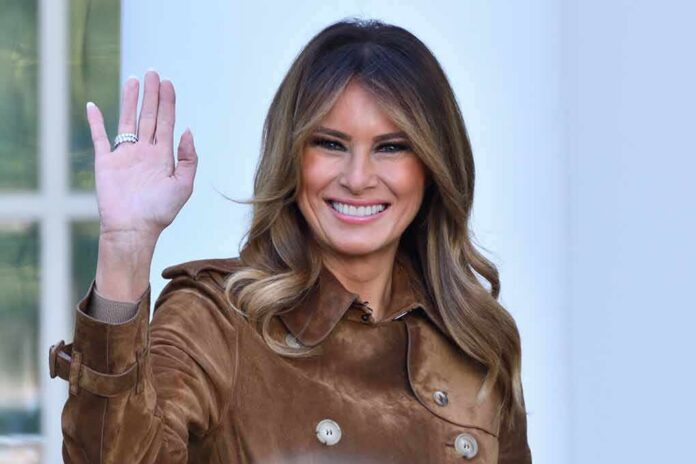
The White House says First Lady Melania Trump helped secure a six-day local ceasefire in war-torn Oleshky so hundreds of civilians could escape and aid could get in.
Story Snapshot
- The White House credits Melania Trump with brokering a localized pause in Oleshky for evacuations and aid.
- Russian and Ukrainian human-rights officials came to the White House for talks hosted by the First Lady.
- The pause reportedly ran October 27 to November 1 and aimed at safe passage and relief deliveries.
- Officials said nearly 800 people evacuated during the window as supplies reached civilians in need.
What Happened: A Local Ceasefire And A High-Profile Meeting
The White House announced that First Lady Melania Trump initiated talks between Russia and Ukraine that led to a ceasefire focused on Oleshky in the Kherson region. The plan called for a halt to military action, humanitarian access, and a marked evacuation route for civilians at set times and places. On November 3, the First Lady hosted representatives from both sides at the White House to discuss the pause and next steps, placing the humanitarian focus at center stage.
Independent outlets reported who attended and why. Ukrainian ombudsman Dmytro Lubinets and Russian human-rights commissioner Yana Lantratova were expected for the meeting, according to officials in both countries. Those roles fit the narrow scope of the talks, which centered on civilian protection and relief rather than a broad political settlement. The event highlighted a targeted effort to reduce suffering, even as wider fighting continued elsewhere in Ukraine.
Scope And Results: Six Days, One Area, Evacuations And Aid
News reports described a defined window for the ceasefire. The pause reportedly started at 3 a.m. local time on October 27 and extended through November 1, covering Oleshky and nearby areas to support aid convoys and safe passage for families trapped by combat lines. The White House said nearly 800 people evacuated during the pause, and local coverage echoed that figure while describing deliveries of food and medicine to residents facing shortages.
These steps matched common features of modern “humanitarian pauses.” Agreements like this focus on access and timing, not on the broader political terms of war and peace. Research shows such limited pauses can reduce harm when they set clear routes, time windows, and contact points for problem solving. Durable peace requires more, but narrow deals can still save lives when parties follow the ground rules.
Why It Matters: Soft Power, Hard War, And Citizen Concerns
The United States government framed the First Lady’s role as a form of soft diplomacy that opened doors for a targeted humanitarian result. Scholars have long noted that first ladies can use soft power to rally support, build trust, and push for specific outcomes in tense settings. That kind of influence does not end wars, but it can create space to help civilians when formal channels stall or focus on military aims.
HAPPENING NOW
First Lady Melania Trump just walked out with officials from BOTH Russia and Ukraine at the White House following her historic Oleshky ceasefire deal to allow humanitarian aide:
"Together, we can create something MORE ENDURING than a temporary ceasefire!"… pic.twitter.com/zCwGJU2Vfj
— Conservative Brief (@ConservBrief) November 5, 2026
Many Americans across the political spectrum worry that leaders in Washington focus on image over impact. This case offers a concrete test: a short pause, a single area, and a clear yardstick of people moved to safety and aid delivered. The record shows a six-day window, stated rules, identifiable participants, and reported evacuations. It is not a peace deal. It is a targeted effort to ease suffering amid a larger war, and that result is measurable on the ground.
Sources:
youtube.com, whitehouse.gov, cbc.ca, themoscowtimes.com, thehill.com
© theredwire.com 2026. All rights reserved.