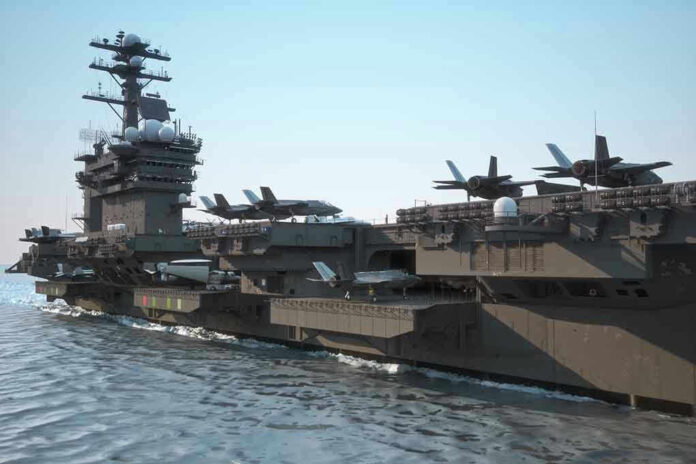
The U.S. Navy’s oldest active aircraft carrier, USS Nimitz, lost two advanced warplanes within 30 minutes during routine operations in the contested South China Sea—raising urgent questions about the readiness of America’s aging fleet and the risks of projecting power in a region where China seeks dominance.
Story Highlights
- An MH-60R Sea Hawk helicopter and an F/A-18F Super Hornet fighter jet crashed into the South China Sea on October 27, 2025, within 30 minutes of each other during operations from USS Nimitz.
- All five crew members were safely recovered and are in stable condition, but the causes of both incidents remain under investigation with official details scarce due to a government shutdown.
- The double loss is exceptionally rare and highlights the inherent dangers of carrier aviation, especially on a nearly 50-year-old ship nearing retirement.
- The incidents occurred in a region where U.S. Navy operations are closely watched by China, adding strategic weight to questions about American military readiness and deterrence.
- Experts warn that continued reliance on aging platforms like the Nimitz, rather than investing in modern replacements, could undermine U.S. naval superiority and embolden adversaries.
Operational Context and Immediate Aftermath
The USS Nimitz, commissioned in 1975 and the flagship of its class, remains the oldest active aircraft carrier in the U.S. Navy. On October 27, 2025, during a routine Indo-Pacific deployment, the carrier’s air wing suffered two separate aviation mishaps in rapid succession. First, an MH-60R Sea Hawk helicopter from Helicopter Maritime Strike Squadron 73 crashed at approximately 2:45 PM local time. Less than half an hour later, an F/A-18F Super Hornet from Strike Fighter Squadron 22 went down after both pilots ejected. The carrier’s search and rescue teams swiftly recovered all five crew members, who are reported in stable condition. The Navy has launched investigations, but official statements are limited, partly due to the ongoing federal government shutdown.
Dual aircraft losses from a single carrier in such a short timeframe are highly unusual, even in the inherently risky world of naval aviation. While the Navy has not released preliminary findings, the lack of immediate explanations has fueled speculation about possible mechanical failures, human error, or environmental factors in the notoriously challenging South China Sea. The Nimitz’s presence in these waters is a deliberate signal of U.S. commitment to freedom of navigation and a counter to China’s expansive territorial claims, but the incidents underscore the operational strain on an aging platform.
Strategic and Political Implications
The South China Sea is a global flashpoint, with China aggressively asserting control over international waters and the U.S. Navy routinely conducting freedom of navigation operations to challenge Beijing’s claims. The loss of two advanced aircraft from the Nimitz—a symbol of American power projection for nearly half a century—comes at a sensitive moment, both geopolitically and domestically. The carrier is on what is expected to be its final operational deployment, and the incidents have reignited debate over the wisdom of extending the service life of legacy platforms versus accelerating investment in next-generation carriers and aircraft.
For conservative audiences, these events are a stark reminder of the consequences of decades of defense spending debates, where short-term budget concerns often delayed critical modernization. The Biden administration’s focus on social and climate initiatives, coupled with congressional gridlock, left the military grappling with aging equipment and deferred maintenance. Now, under President Trump’s renewed emphasis on military strength, the incidents on the Nimitz highlight both the urgency of revitalizing America’s defense industrial base and the risks of allowing strategic competitors like China to perceive weakness.
Broader Concerns: Readiness, Accountability, and American Resolve
Beyond the immediate operational impact, the dual crashes raise serious questions about the Navy’s ability to maintain a high state of readiness amid increasing global demands. The South China Sea is not only a contested waterway but also an environment known for its complex weather and operational challenges. Past incidents, such as a Super Hornet being blown off the deck of the USS Harry S. Truman in 2022 and the accidental shootdown of a U.S. fighter in the Red Sea in 2024, demonstrate that even routine operations carry significant risk. However, the near-simultaneous loss of two aircraft from a single carrier is unprecedented in recent memory and demands a thorough, transparent investigation.
For the families of sailors and aviators, the priority is assurance that every possible measure is taken to protect their loved ones. For the American public, especially those who prioritize a strong national defense, the incidents are a call to action: to hold leadership accountable, to demand realistic defense budgets, and to reject the complacency that allowed critical platforms to age without timely replacement. The strategic stakes could not be higher—a credible U.S. naval presence in the Indo-Pacific is essential to deterring aggression and preserving the rules-based international order that has kept the peace for generations.
A fighter jet and a helicopter based off the aircraft carrier USS Nimitz both crashed into the South China Sea within 30 minutes of each other, the Navy’s Pacific Fleet said. https://t.co/zq5he745FE
— FOX16 News (@FOX16News) October 27, 2025
Looking Ahead: Modernization and American Strength
As investigations continue, the focus will inevitably turn to the future of the U.S. carrier fleet. The Nimitz-class ships have served with distinction, but the physical limits of metal and machinery cannot be ignored. The incidents of October 27 should accelerate bipartisan support for the timely introduction of the Gerald R. Ford-class carriers and next-generation aircraft, ensuring that America’s sailors have the best tools to defend the nation’s interests. In an era of great-power competition, there is no room for half-measures or misplaced priorities—especially when the credibility of American deterrence is on the line.
Sources:
The Aviationist: USS Nimitz Loses Sea Hawk and Super Hornet in South China Sea Within 30 Minutes
Task & Purpose: Navy confirms F/A-18, helicopter crash from USS Nimitz in South China Sea
The Jerusalem Post: US Navy loses two aircraft from USS Nimitz in South China Sea