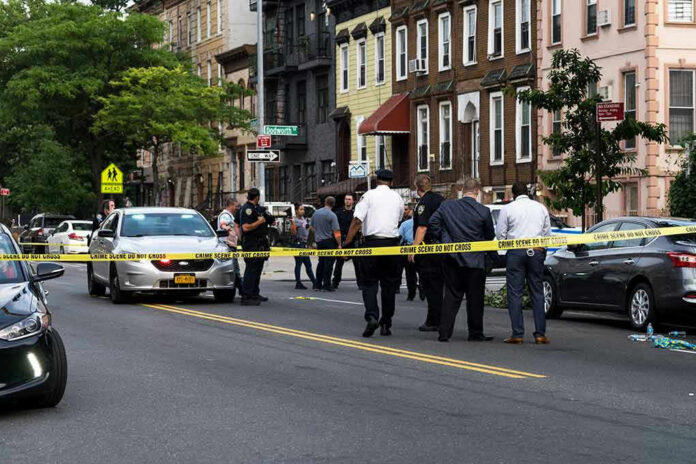
A car tore across Modena’s Via Emilia, mangled bodies in its wake, and the man behind the wheel allegedly reached for a knife as onlookers closed in—yet investigators still will not say why.
Story Snapshot
- Reports describe a driver mounting the sidewalk in Modena, striking multiple pedestrians, then abandoning the car [1][2]
- At least seven people were injured, with several in serious condition, according to police-cited reporting [1][2]
- A stabbing attempt after the crash was alleged by secondary media, but not formally confirmed by police in available reports [1]
- Investigators publicly kept both accident and deliberate attack on the table pending evidence [1]
What Happened On Via Emilia And Why It Matters
Modena authorities detained a 31-year-old man after a Citroën C3 mounted the sidewalk on Via Emilia and plowed into pedestrians before smashing into a storefront on May 16, 2026, according to contemporaneous reporting that cites police for injury counts [1]. A separate outlet reported seven injured, four seriously, after the driver went onto the sidewalk [2]. The suspect allegedly attempted to stab a passer-by who tried to stop him after he fled the vehicle, a detail carried by secondary media without a quoted police confirmation in hand [1].
Conflicting tallies—“at least ten struck” in one account and “seven injured” in another—reflect the chaos of early reporting rather than a settled record [1][2]. Reports agree on the physical sequence: the car left the roadway, people were hit, the vehicle collided with a shop front, and the suspect was detained and questioned [1][2]. The outcome for victims was grave; police-cited accounts described multiple serious injuries, including one woman losing both legs, a pattern more often associated with deliberate acceleration than a low-speed mishap, though that inference awaits forensic testing [1].
What Police Have And What They Do Not
Investigators told reporters they were examining all possible explanations, explicitly naming accident and deliberate action while withholding a motive pending evidence [1]. That public stance signals neither exoneration nor confirmation; it reflects standard procedure until closed-circuit television, vehicle data, medical evaluations, and sworn witness statements align. The alleged knife element remains secondhand in the available materials; no arrest affidavit or charging document is provided in the cited reports to verify weapon recovery or attack intent [1]. Assertions should track the evidence, not the headlines.
Early accounts present enough red flags to justify the public’s suspicion. A vehicle on a sidewalk, multiple critical injuries, flight on foot, and alleged post-crash aggression commonly correlate with intentional harm in past cases. Yet investigators left accident on the table. A fair-read, facts-first approach rooted in common sense says: hold the intent verdict until reconstruction data show steering inputs, throttle patterns, and braking behavior consistent with targeting, or until toxicology and medical records exclude incapacitation. That patience is not weakness; it is discipline.
The Evidence That Can Settle Intent
Closed-circuit television from Via Emilia, storefront cameras facing the collision path, and any dash-mounted devices can establish trajectory and speed frame by frame. Event data recorders—when present—can reveal throttle position, brake application, and steering angle in the seconds before impact. Forensic inspection of tire marks and impact points can test whether the path reflects course corrections toward pedestrians or uncontrolled drift. Toxicology and emergency-room notes can rule in or out impairment, seizure, or other medical crises that mimic hostile driving [1][2].
Car rams into pedestrians in Modena Italy, injuring 8, and four are in a serious condition.
It has been reported that the driver attempted to flee but was stopped by locals and is now in police custody.
Witnesses also say the man was holding a knife.
https://t.co/Q0AEiBkjeW pic.twitter.com/I3oQXCUL7M— Patriotic 🇬🇧 Nation (@HoodedClaw1974) May 16, 2026
Witnesses who chased the suspect and the passer-by allegedly targeted with a knife can clarify post-crash behavior under oath. If the suspect brandished a blade or made threats, prosecutors will likely memorialize it in filings. If the knife story dissolves under scrutiny, that matters for motive. If it hardens, it amplifies a pattern of hostility. Either way, a clean evidentiary chain—video, vehicle data, sworn statements—beats viral summaries every time.
Why Caution Beats Clicks
News outlets quickly framed Modena as a car-ramming with a knife chase; the available reports echo that template, with vivid injury details and a suspect in custody [1][2]. Police still have not confirmed intent, a point that should anchor public judgment. When facts are fluid, American conservative values—personal responsibility balanced by due process—counsel restraint: demand thorough investigation, punish proven malice hard, and refuse to let narrative outrun proof. If later evidence shows deliberate targeting, call it what it is. If it shows impairment or medical collapse, adjust accordingly.
Sources:
[1] Web – Horror in Modena as car rams into pedestrians on busy Italian street
[2] Web – Video: Man Drives Into Pedestrians, Then Chases People With Knife …