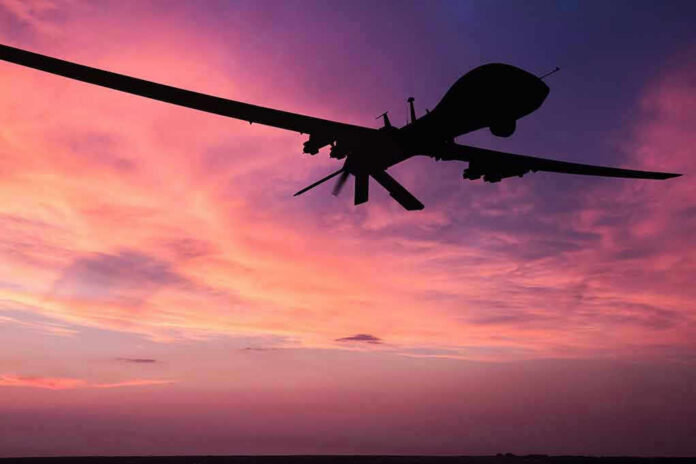
Mexican cartel drones reportedly breached U.S. airspace near El Paso—triggering a rare FAA shutdown that looked like a post-9/11 security lockout.
Quick Take
- The FAA issued sudden notices halting flights around El Paso International Airport for “special security reasons,” initially slated to last 10 days.
- Local authorities and even nearby military stakeholders were caught off guard as flights stopped across commercial, cargo, and emergency operations.
- Reports indicate cartel drones crossed into U.S. airspace from Mexico, prompting federal action.
- The FAA rescinded the planned 10-day closure after the Department of Defense disabled the drone threat, restoring operations within hours.
FAA Airspace Lockdown Hits a Major Border Hub
The Federal Aviation Administration abruptly shut down airspace around El Paso International Airport starting at 11:30 p.m. Mountain Time on Feb. 10, with restrictions posted to run through Feb. 20. The order halted flights inside a 10-nautical-mile radius up to 17,000 feet, affecting commercial airlines, cargo, general aviation, military activity, and even medical flights. El Paso, a city of roughly 700,000, relies on the airport as a regional gateway for travel and commerce.
El Paso International Airport quickly notified travelers that flights were canceled, while the city issued an advisory saying the temporary flight restriction “appears to be security related.” The suddenness of the shutdown mattered as much as its scale. An FAA contact involved in the process described receiving directives with little context, underscoring how fast “special security” decisions can cascade from federal channels down to local airports and families stuck scrambling for alternatives.
What Triggered the Shutdown: Drone Breach and a Fast Federal Response
Multiple reports tied the emergency restriction to Mexican cartel drones that crossed into U.S. airspace—an escalation beyond routine border surveillance concerns. An administration official told reporters that cartel drones breached U.S. airspace and that the Department of Defense took action to disable them. One outlet quoted the phrase “Department of War,” which appears to be a misstatement for DoD, but the core claim across coverage was consistent: the threat was addressed quickly enough to prevent a prolonged closure.
The FAA later lifted the temporary halt, effectively canceling what had looked like a sweeping 10-day shutdown. That reversal matters for two reasons. First, it indicates officials believed the immediate threat was neutralized. Second, it shows how close a single hostile incursion came to locking down aviation over a major American border city for more than a week. Sources described the measure as the kind of rare security action most Americans associate with the period after Sept. 11, 2001.
Why El Paso Is Sensitive Airspace—And Why This Incident Stands Out
El Paso sits at the center of an intensely active border corridor linking West Texas, southern New Mexico, and northern Mexico, including nearby Ciudad Juárez. The region also hosts routine Defense Department drone operations out of bases near the airport, including Fort Bliss, aimed at countering cartel activity. That context initially fueled confusion because locals are used to military aviation in the area. This incident stood out because coverage described hostile cartel drones crossing into U.S. airspace, not standard U.S. operations.
The NOTAM footprint also showed how wide the disruption could have become. Reports indicated the restricted area covered most of El Paso County and extended into southern New Mexico west of Santa Teresa, while excluding Mexican airspace and Santa Teresa’s airport. For residents, that means the impact was not confined to one terminal. A broad airspace restriction can ripple into cargo schedules, regional connections, and emergency services—real-world consequences that go far beyond delayed vacations.
What’s Known, What’s Still Unclear, and What to Watch Next
The available reporting answers the “what happened” question better than the “how did it happen” question. Sources agree that the FAA imposed a major restriction for security reasons, that cartel drones were linked to the incident, and that DoD action preceded the reopening. What remains unclear is how many drones were involved, how far they penetrated, and what specific counter-drone methods were used. The FAA’s limited public detail added to early uncertainty as the story developed.
JUST IN: Cartel Drone Breach of US Airspace Responsible for Closure of El Paso, TX Airspace – FAA Rescinds 10-Day Closure After Threat 'Neutralized' https://t.co/sB27ic4bhQ #gatewaypundit via @gatewaypundit
— † Crusader (@Wil_Johnson1) February 11, 2026
For Americans already frustrated by years of chaotic border enforcement, the larger takeaway is straightforward: this was not a theoretical vulnerability. A cross-border criminal threat reportedly forced federal authorities to halt air traffic over a major U.S. city, even if only briefly. The rapid reopening is a practical win for public safety and normal life, but the incident also signals a need for stronger, clearer counter-drone and border security protocols—especially where civilian infrastructure meets cartel territory.
Sources:
Drone use at center of El Paso airspace shutdown
El Paso airport closes for 10 days due to special security reasons
FAA lifts temporary halt in El Paso tied to potential military drone