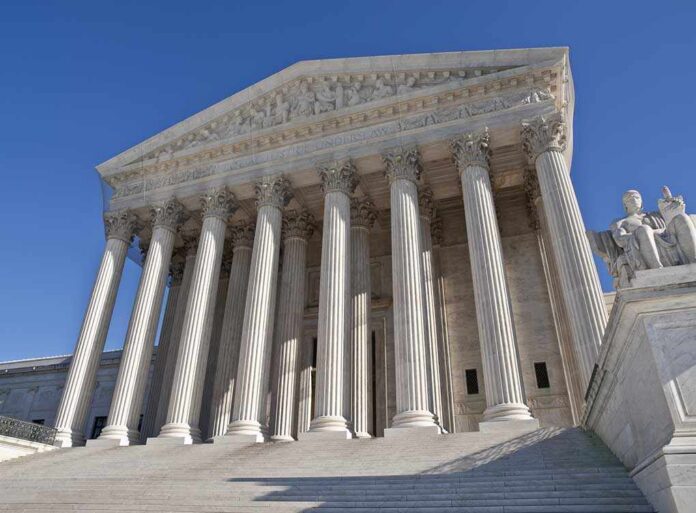
One Supreme Court case could decide whether being born on American soil still guarantees an American passport.
Story Snapshot
- President Trump personally attended April 1, 2026 oral arguments over his executive order restricting birthright citizenship, then departed during the session.
- The challenged order targets babies born in the U.S. to parents without permanent legal status, aiming to deny automatic citizenship.
- ACLU lawyers argue the policy clashes with the 14th Amendment’s text and more than a century of legal precedent.
- Lower courts have blocked the order so far; the Supreme Court is now weighing the merits with no ruling yet.
A courtroom drama with unusually high stakes: citizenship at birth
President Trump’s decision to show up for Supreme Court arguments in Trump v. Barbara signaled more than political theater. The case goes straight to the country’s operating system: who qualifies as a citizen from the first breath. Trump left during proceedings, but the argument kept moving toward the core question—whether an executive order can narrow birthright citizenship for U.S.-born children whose parents lack permanent legal status.
The ACLU’s counsel put a human number on what can sound like abstract constitutional law, warning that “thousands” of babies would lose automatic citizenship, and separately projecting impacts in the millions over a couple decades. Those estimates function like a spotlight: they force the justices, and the public, to think beyond policy slogans and toward real families facing paperwork limbo, uncertain status, and the quiet long-term costs of a life that starts with a legal question mark.
How the executive order tried to redraw the 14th Amendment
Trump signed the birthright citizenship executive order on January 20, 2025, the first day of his second term, with a start date for babies born after February 19, 2025. The design mattered: by limiting eligibility based on parents’ permanent legal status, the order tried to do through administrative action what normally requires Congress or a constitutional amendment. Lawsuits landed fast—within hours—before the policy could take hold.
Federal courts blocked the order early, and that consistent resistance shaped the case’s path to Washington. When the Supreme Court later limited nationwide injunctions, plaintiffs pushed a class-action route to keep the issue from splintering into a state-by-state patchwork. That maneuver turned Barbara into something bigger than one family’s dispute. It framed the case as a national question: one rule for every baby born under the same flag.
The legal fault line: “subject to the jurisdiction” and a century of practice
Birthright citizenship rests on a compact sentence from 1868: “All persons born or naturalized in the United States, and subject to the jurisdiction thereof, are citizens.” The modern fight usually turns on the second clause. The ACLU argues the text is plain in normal circumstances and that the Supreme Court’s 1898 decision in United States v. Wong Kim Ark cemented the rule for children born here, with narrow historical exceptions. Federal statute also reflects that understanding.
Trump’s side, as summarized in the available research, presses a tighter reading of “jurisdiction,” aiming to exclude children born to parents without permanent legal status. The research set provided does not detail the administration’s full theory or how it would manage edge cases. That absence matters because durable law survives contact with messy reality: mixed-status families, temporary visas, asylum claims, and children born while paperwork drags on for years.
What conservatives should demand from both sides: clarity, limits, and constitutional honesty
Immigration policy deserves seriousness, not slogans. Conservatives can reasonably argue that incentives matter and that the U.S. should control borders, enforce visa terms, and reduce chaos that strains schools, hospitals, and local budgets. Those goals align with common sense and national sovereignty. The issue here is the tool. Executive orders can direct agencies, but they cannot rewrite constitutional guarantees by interpretation so aggressive it functions like amendment-by-memo.
The ACLU’s claim that “no president can change the 14th Amendment” is persuasive as a matter of separation of powers, especially given the lower courts’ uniform blocks described in the research. If the country wants a different citizenship rule, the honest route runs through legislation and, if needed, the amendment process—painful, slow, and legitimate. Shortcuts invite whiplash: one president tightens, the next loosens, and families pay the price.
The impact question that never goes away: millions of lives, years of uncertainty
Even the smaller estimate—“thousands” affected—represents a large administrative and human burden. Citizenship is not only a passport. It determines access to lawful work later, eligibility for certain benefits, security clearances, voting, and the confidence that you belong where you were born. The larger projection—roughly five million over twenty years—raises a different question: what does America become if a growing class of U.S.-born residents must prove, and re-prove, they qualify?
Supporters of narrowing birthright citizenship often believe the change would reduce illegal immigration over time. That claim remains contested and requires more than intuition; migration responds to jobs, enforcement, asylum policy, and conditions abroad. Meanwhile, the immediate governance problem looks concrete: creating a complicated “citizen versus not” determination at the hospital bedside invites errors, fraud opportunities, and bureaucratic churn. Stability in rules matters, especially for something as basic as identity.
What happens next after the arguments and Trump’s exit
Oral arguments rarely tell you the ruling, but they reveal what the justices fear: unworkable lines, unintended consequences, and legal reasoning that cannot survive its own logic. With the order still blocked and no decision yet, the country sits in a familiar posture—immigration politics racing ahead while the judiciary insists on constitutional process. The justices now decide whether the traditional reading holds firm or whether a major shift can emerge without Congress.
The most revealing part of this episode may not be Trump’s departure, but the underlying choice the Court faces. A nation can enforce borders aggressively and still keep constitutional promises intact. The hard work comes from doing both at once—tightening systems without inventing new constitutional meanings on the fly. The ruling, when it comes, will echo long after the headlines fade, because it answers a question every American understands instantly: what does it take to belong?
Sources:
ACLU files new brief in birthright citizenship case of SCOTUS arguments
Federal appeals court upholds block on Trump birthright citizenship executive order
Federal appeals court upholds block on Trump birthright citizenship executive order
Supreme Court to hear high-stakes birthright citizenship challenge