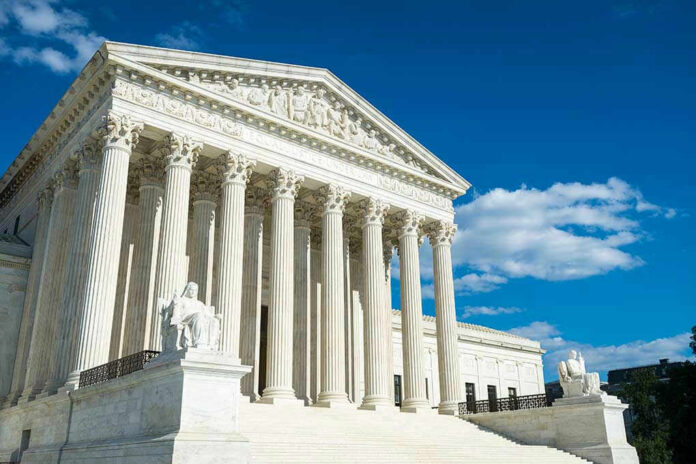
With Washington rumor mills already circling the Supreme Court, President Trump is openly floating Ted Cruz as a potential pick—signaling Republicans want to lock in the Court’s constitutional direction before the 2026 midterms change the math.
Quick Take
- No Supreme Court vacancy exists yet, but speculation is growing because several justices are in their 70s and midterm politics are closing in.
- Trump publicly praised Sen. Ted Cruz’s legal credentials and suggested Cruz could be a consensus nominee if an opening appears.
- Republicans hold a 53-47 Senate majority, creating a clear confirmation path now that could tighten after November 2026.
- Reporting and court trackers say there are no retirement announcements; the current drama remains speculation, not a formal nomination process.
Trump’s Cruz Tease: A Signal, Not a Nomination
President Donald Trump sparked fresh Supreme Court chatter after publicly musing about nominating Texas Sen. Ted Cruz. Trump praised Cruz as a “brilliant” legal mind and joked that both parties might like the idea if it removed Cruz from the Senate. The key point for voters is procedural: there is no vacancy and no nomination underway. The comments function as political positioning while the Court remains fully staffed.
Trump’s remarks landed in a familiar environment: Washington talks constantly about potential Court openings when justices reach advanced ages. Clarence Thomas is 77, and speculation routinely centers on whether a justice might time retirement during a politically friendly presidency. Court watchers, however, report routine operations and no public retirement announcements. That means the Cruz conversation is best understood as “if-and-when” planning rather than evidence that a seat is about to open.
Why Timing Matters: Senate Control and the 2026 Midterms
Republicans currently hold a 53-47 Senate majority, and that arithmetic shapes every Supreme Court conversation. If a vacancy appeared before the 2026 midterms, a disciplined GOP conference could move a nominee through the Judiciary Committee and to a final vote without needing Democratic support. If the Senate flips in November 2026, the same vacancy could produce delays, bargaining, or a complete blockade, depending on margins and leadership decisions.
That political urgency is not hypothetical. Trump’s first term showed how narrow margins still allow confirmations, even amid unified Democratic opposition. During that earlier period, Trump appointed Neil Gorsuch, Brett Kavanaugh, and Amy Coney Barrett—appointments that helped produce today’s 6-3 conservative majority. With no current opening, the “fourth justice” question is really a timing question: whether any retirement occurs early enough for the current Senate to act.
Cruz’s Profile and the Practical Trade-Off for Republicans
Cruz is not a random name in conservative legal circles. He has credentials that are easy to summarize to voters and senators alike: prior service as Texas solicitor general, experience arguing before the Supreme Court, and a background that includes clerking for Chief Justice William Rehnquist. Trump previously included Cruz on a Supreme Court shortlist. If Trump seriously pursued Cruz, Republicans would weigh jurisprudential reliability against the cost of losing a Senate seat.
That cost matters because a sitting senator leaving for the Court triggers a chain reaction at home. Texas would face a replacement process that could include a special election, and national party strategists would immediately calculate risk. The Court seat is lifetime; the Senate seat is not. For voters focused on constitutional interpretation, that trade-off can look worthwhile. For party leaders counting votes, it introduces uncertainty in an already tight chamber.
What the “Weakest Link” Debate Shows About the Stakes
Some commentary on the right and left treats Supreme Court justices like guaranteed votes on hot-button cases, but recent analysis complicates that narrative. Data-driven reviews of voting patterns suggest Trump’s three appointees are generally conservative yet not identical in how often they join narrow liberal outcomes or break from blocs. That reality is one reason the next pick—if it happens—would likely be vetted intensely by conservative legal networks focused on text, structure, and constitutional limits.
For conservatives frustrated by years of bureaucratic overreach, the Supreme Court remains the final check that can restrain executive agencies and defend enumerated rights. The Constitution’s separation of powers does not enforce itself; it depends on judges willing to apply it even when political pressure runs the other way. That helps explain why Republicans see the Court not as a “culture-war trophy,” but as a core guardrail against unelected rulemaking and shifting ideological demands.
Bottom Line: A Fourth Pick Depends on a Vacancy—and a Clock
As of mid-February 2026, there is still no vacancy, no announced retirement, and no formal indication that the Court’s membership will change soon. Trump’s Cruz talk underscores how prepared the White House wants to be if an opening appears, and it highlights why Senate control in 2026 is so consequential. If a justice retires before the midterms, Trump could plausibly secure a fourth appointment; if not, the window narrows fast.
Limited public information is available beyond routine court updates and Trump’s own comments, so any claim that a specific justice is definitely retiring goes beyond the confirmed record. Conservatives can reasonably track two hard facts instead: the Court is currently unchanged, and the Senate map will determine how quickly any future nomination can be confirmed. Until a justice announces a departure, everything else remains political speculation.
Sources:
SCOTUStoday for Tuesday, February 17
Trump floats Cruz for Supreme Court
Which of Trump’s Supreme Court nominees is the weakest link?
List of federal judges appointed by Donald Trump
Paucity of vacancies slows Trump’s effort to reshape courts
Biographies of Current Justices of the Supreme Court
Women federal judges Trump second term