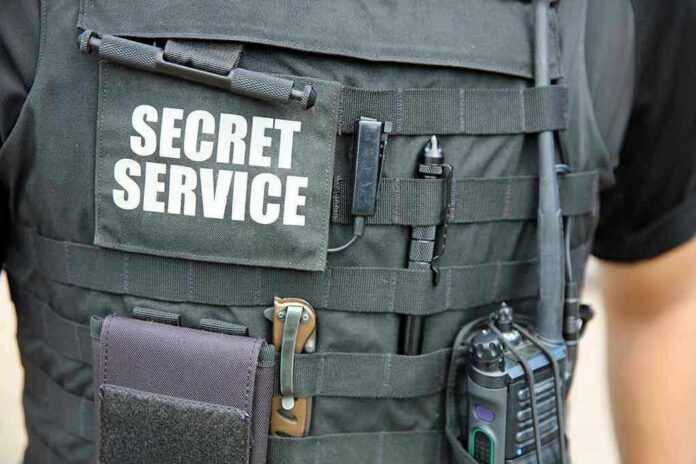
A Secret Service badge means nothing if the person wearing it can be bought, blackmailed, or publicly compromised.
Quick Take
- A developing report alleges an adult content creator posted explicit videos involving a Secret Service agent on OnlyFans.
- No agent identity, posting dates, assignment details, or official agency response appear in the available reporting.
- The biggest risk isn’t prudishness; it’s coercion, reputational damage, and operational distraction inside a protective mission.
- With only one relevant source available, readers should separate confirmed facts from plausible implications.
What the developing report claims, and what it does not
The available reporting centers on a single allegation: adult content creator Brittney Jones posted graphic videos on OnlyFans that depict sex acts involving a Secret Service agent. That’s the whole factual payload as currently described, and it arrives labeled as a “developing” exclusive. No dates, no location, no protective detail assignment, no agent name, and no confirmation from the Secret Service appear in the material provided. The unanswered questions matter as much as the claim.
'Lives a Double Life' – Sex Content Creator Posted Graphic Videos of Sex Acts with Secret Service Agent on OnlyFans… Developing https://t.co/WTcDa97HJB #gatewaypundit via @gatewaypundit
— LeonidasOfSparta❤️🇺🇸 🇬🇧🇮🇱TRUMP (@Skylark57) April 19, 2026
That absence of specifics creates a familiar problem for readers: the story feels instantly scandalous, but the key details that turn scandal into accountability are missing. If the videos exist as described, investigators would want to know when they were made, whether the agent used government time or resources, whether any identifying insignia appears, and whether the agent had access to protectees or sensitive locations while entangled in monetized content.
Why adult content plus federal protection work creates a national security risk
Secret Service work runs on trust, discretion, and disciplined routine. Agents stand close to power, travel through secure spaces, and operate under constant threat modeling. Adult content itself isn’t a felony, but monetized explicit material tied to a federal protector invites three predictable hazards: coercion, distraction, and exposure. Coercion comes from the simplest leverage in the world—“pay me, do what I want, or I release this.” Distraction grows when leadership must manage fallout instead of mission.
Exposure can be almost comically easy. A background reflection reveals a hotel layout. A uniform item appears. A phone notification pops up. A recognizable voice, tattoo, or watch triggers identification. Even if nothing classified appears, protective work doesn’t require “classified” to be dangerous. It requires predictability, access, and proximity. Conservative common sense says federal personnel who protect presidents and candidates must live like they can be targeted—because they can.
The double-life angle: who benefits, who pays, and who gets blamed
The “double life” framing sells because it mirrors a modern reality: people build one life for payroll and another for platforms. OnlyFans monetization turns private conduct into a product, and products invite competitors, disputes, and grudges. If a Secret Service agent appears in commercially distributed explicit content, the agent becomes a commodity and a vulnerability at the same time. The person holding the footage holds leverage, and leverage travels fast in a digital economy.
The political temptation is to treat this as either moral panic or culture-war fuel. That misses the practical issue: employment in a federal protective service is not a normal job. Agents accept stricter standards precisely because the stakes are higher. Conservative values emphasize duty, self-control, and respect for institutions that keep the country stable. A protector who acts carelessly off-duty can still endanger on-duty operations, even if no law is broken.
What responsible readers should demand before drawing conclusions
Single-source stories can be true, partly true, or weaponized. With the current information, a responsible standard starts with verification: confirm the existence of the content, verify the agent’s employment status, and establish a timeline. Next comes scope: did the material show anything that identifies protective methods, locations, or equipment? Then comes conduct: did the agent violate ethics rules, security policies, or laws? Without those steps, outrage turns into guesswork.
American conservatives have learned—sometimes the hard way—that institutions protect themselves unless pressured by clear facts. If the allegation proves accurate, the Secret Service should respond with transparent process: confirm whether an investigation is open, describe general conduct standards, and assure the public that protectee security isn’t compromised. If the allegation proves false or exaggerated, the agency should still explain what it can to restore confidence. Silence invites rumors to take over.
The bigger pattern: digital blackmail is cheaper than ever
The modern scandal isn’t sex; it’s permanence. The internet doesn’t forget, and adversaries don’t forgive. A foreign intelligence service doesn’t need a Hollywood-style honey trap when social media does the recruiting and adult platforms do the archiving. Financial stress, desire for attention, and low perceived risk can pull even trained professionals into reckless choices. When the job involves guarding national leadership, personal discipline isn’t a virtue signal; it’s a security control.
Limited data is available from the provided research, so the best insight comes from the predictable mechanics of compromise. Videos, subscriptions, and private messages create a trail. Trails can be purchased, leaked, or hacked. Even if consent exists between participants, consent doesn’t stop exploitation by third parties. The question isn’t whether adults can do what they want; it’s whether a protector can keep adversaries from using it against the mission.
"Lives a Double Life" – Sex Content Creator Posted Graphic Videos of Sex Acts with Secret Service Agent on OnlyFans… Developing | The Gateway Pundit | by Cristina Laila https://t.co/GJFuScopU1
— Gayle (@MesaWall) April 19, 2026
The developing nature of this report leaves the public in a familiar limbo: enough smoke to worry, not enough verified detail to judge. If later reporting confirms the allegation, the corrective action should focus on operational integrity, not tabloid punishment. If later reporting undercuts it, that should also be said plainly. Either way, the take-home lesson is uncomfortable and simple: government security work demands a life built to withstand leverage.