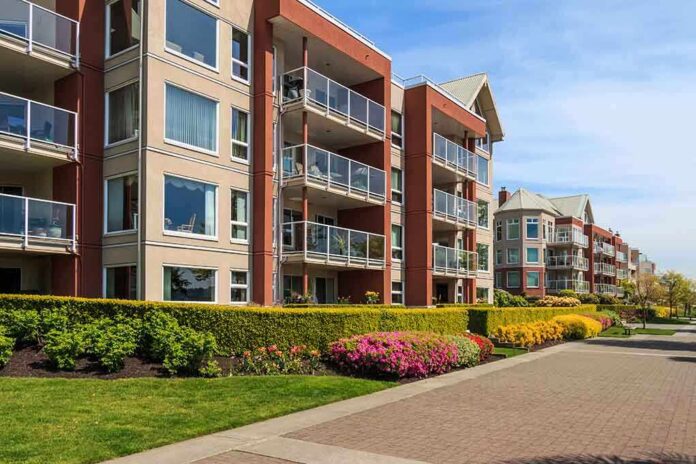
The American condo didn’t “crash” all at once—it got squeezed, quietly, from three sides until owners started blinking first.
Quick Take
- Condo prices and demand weakened into early 2026 while single-family homes cooled more slowly.
- Mortgage rates, insurance spikes, and rising HOA fees turned “affordable urban living” into a monthly-budget ambush.
- Florida became the stress test: post-Surfside safety rules and insurance turmoil pushed fees and special assessments higher.
- Data points flashing yellow include a sharp drop in pending sales, rising cancellations, and swelling inventory in key metros.
The “collapse” is a slow-motion math problem, not a single headline
Condo trouble in 2026 looks less like a dramatic free fall and more like a spreadsheet breaking families’ patience. The same unit can lose value while costing more to own each month, thanks to higher mortgage payments, higher insurance, and higher association dues. When that happens, buyers disappear first, then investors, then the owners who can’t carry the load. That’s how a market “collapses” without one defining day.
National numbers help explain the mood: pending sales slid hard at the end of 2025, and analysts tracked higher cancellation rates as buyers walked away mid-deal. That’s not just jitters; it’s what happens when the inspection reveals a looming special assessment, or the lender gets skittish about a building’s reserves, or the monthly payment recalculates at today’s rates. Condos are uniquely sensitive because shared governance magnifies every surprise.
Why condos break first: shared walls, shared risk, shared bills
Single-family homeowners can delay a roof replacement or shop around for contractors. Condo owners can’t, because the building is a group responsibility governed by an association, budgets, and votes. That structure works in stable times. In stressed times it turns into conflict: owners on fixed incomes versus owners demanding repairs, long-time residents versus newer buyers who expected predictable fees. The market prices that tension in immediately, often brutally.
Aging buildings add pressure that no glossy listing can hide. Many condo towers and complexes hit the 30-to-50-year window when major systems start failing together: concrete, plumbing, elevators, roofs, electrical. Deferred maintenance doesn’t stay deferred forever. Once engineers and inspectors get involved, the “cheap” unit reveals its real price through assessments and sharply higher monthly dues. Buyers smell those future bills, and they discount the unit or walk away.
Florida’s condo crisis became the national warning label
Florida sits at the intersection of every condo vulnerability: coastal weather risk, high insurance volatility, and a vast inventory of older buildings. After the 2021 Surfside tragedy, the state tightened rules around inspections and funding reserves. The public policy logic is hard to argue with: buildings need to be safe, and associations need money set aside for real repairs. The financial impact, though, landed directly on owners through higher dues and assessments.
Insurance amplified the problem. Premiums didn’t just rise; in some cases they surged enough to change who can qualify for ownership at all. When insurance jumps, associations pass costs to residents, and lenders scrutinize the building’s financial health. That puts condos into a tighter box than single-family homes: buyers face a higher monthly nut, owners face higher carrying costs, and associations face pressure to fund reserves quickly. Florida’s price declines reflect that choke point.
Oversupply and investor pullback turned condos into the weakest link
Developers built and planned inventory based on a recent past that now looks like a different country: cheap money, strong rent growth, and robust urban demand. By early 2026, several cities showed the opposite mix—more listings, softer rent expectations, and buyers who refuse to pay yesterday’s price for tomorrow’s uncertainty. That matters because condos rely heavily on marginal demand: investors, second-home buyers, and move-down purchasers seeking low maintenance.
When investors leave, condos feel it first. The investor doesn’t care about the view or the lobby; the investor cares about cash flow and exit value. Higher fees and insurance crush cash flow. Higher rates crush buyer affordability at resale. That double hit makes “wait it out” less attractive, so inventory rises and price cuts follow. Some commentary blames big institutions broadly, but the stronger, simpler explanation is incentives: money flees when the risk-adjusted return turns ugly.
What the late-2025 data said out loud: buyers were tapping the brakes
Pending sales falling at the end of 2025 signaled more than seasonal weakness; it showed consumers rejecting the deal on the table. Older Americans recognize this pattern: when the payment shocks the buyer, the market doesn’t negotiate with feelings—it reprices. Condo repricing tends to be faster because similar units compete directly within the same building and because bad news spreads instantly through HOA documents, inspection reports, and lender guidelines.
Some analysts point to early signs of stabilization in parts of the condo market, and that may prove true in pockets where buildings are newer, reserves are healthy, and insurance is manageable. A nationwide “total collapse” claim demands caution. Condos don’t move as one national market; they fracture by building quality, governance, state regulation, and local supply. The most persuasive evidence supports a segment slump concentrated in high-fee, high-risk areas.
What this means for owners and buyers in 2026: demand now comes with conditions
Condo owners face a harsh choice set: pay the higher monthly costs, sell into a softer market, or risk getting trapped when buyers and lenders avoid the building. Buyers hold more leverage than they’ve had in years, but they need a different checklist: reserve funding, upcoming inspections, history of assessments, insurance trendlines, and rules that limit rentals. The deal isn’t the price; the deal is the building’s balance sheet.
The conservative, common-sense takeaway is simple: ownership works when obligations are clear and predictable. Condos blur that line because your neighbor’s vote can become your bill, and politics can become maintenance. Safety reforms after Surfside make moral and practical sense, but policymakers and associations must also respect affordability realities, especially for retirees. If the condo market “turns the corner,” it will do so by restoring trust: funded reserves, insurable properties, and honest pricing.
Sources:
https://finbold.com/why-the-entire-u-s-housing-market-could-collapse-in-2026/
https://www.indexbox.io/blog/condo-market-shows-early-signs-of-recovery-after-prolonged-downturn/