
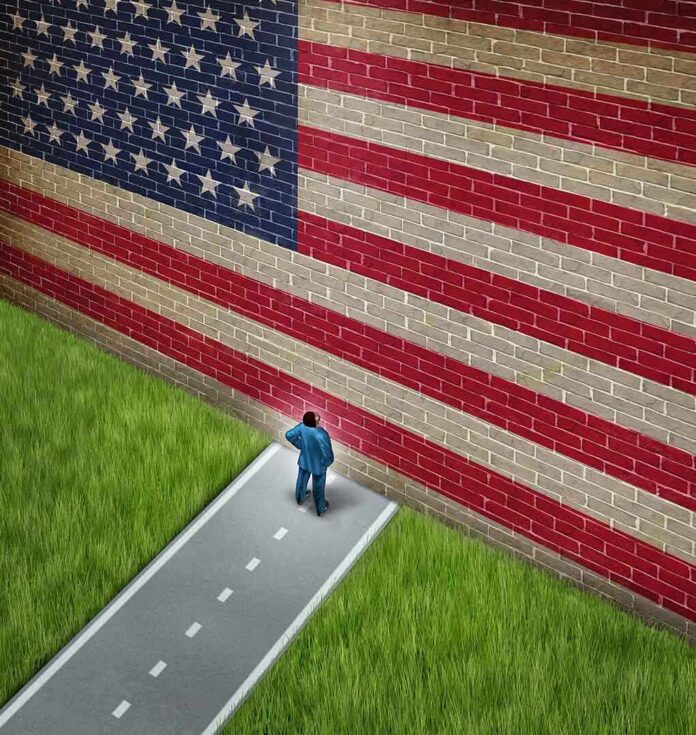
President Trump’s new executive order to aggressively prosecute flag desecration has ignited a fierce debate over free speech, patriotism, and the limits of government power—testing the boundaries of the First Amendment and signaling a dramatic shift from the previous administration’s approach.
Story Highlights
- Trump signs executive order mandating prosecution for desecrating the American flag, including flag burning.
- The order threatens immigration benefits for foreign nationals involved in flag desecration.
- This action directly challenges Supreme Court precedent that protects flag burning as free speech.
- Legal experts anticipate immediate constitutional challenges as civil liberties groups prepare court action.
Trump’s Executive Order Targets Flag Desecration with Aggressive Prosecution
On August 25, 2025, President Donald Trump signed an executive order instructing the Attorney General to prosecute to the fullest extent those who desecrate the American flag, including burning it during protests. The order further directs federal agencies to deny immigration benefits to foreign nationals found to have participated in flag desecration, and refers cases to state and local authorities as needed. The White House framed this move as a response to recent high-profile flag burning incidents and an effort to reinforce the sanctity of national symbols.
Unlike prior legislative attempts, this executive action does not create new criminal statutes but instead commands more aggressive use of existing laws. The order aims to clarify the limits of First Amendment protections and seeks to penalize foreign nationals through immigration consequences. Such a move marks a significant escalation in the federal response to acts seen by many conservatives as deeply disrespectful, especially after years of what they view as leniency under left-leaning administrations.
Legal and Historical Context: Supreme Court Precedent and Political Debate
Flag desecration has divided the nation for decades, with the Supreme Court’s landmark 1989 Texas v. Johnson decision establishing flag burning as protected symbolic speech under the First Amendment. Congress’s Flag Protection Act of 1989 was subsequently struck down, and repeated efforts to ban desecration through constitutional amendment have failed. The Trump administration’s order reignites this longstanding battle, directly challenging established legal precedent and reigniting debate over the proper balance between free expression and national honor.
Recent protests, particularly in Washington, D.C., have brought flag burning back to the national spotlight, fueling public frustration over perceived anti-American sentiment and foreign influence. The Trump administration’s action is seen as a bid to restore public order and patriotic values, directly confronting what supporters view as a decline in respect for foundational symbols. This policy shift reflects a broader trend of prioritizing national identity, public order, and conservative values in response to what many see as years of unchecked protest and cultural upheaval.
Stakeholder Reactions and Anticipated Legal Battles
The executive order has mobilized a range of stakeholders. President Trump and Attorney General Pam Bondi have championed the directive as necessary to protect the flag and deter provocative acts. The Department of Justice and Homeland Security are now tasked with interpreting and enforcing these new directives, which include denying immigration benefits and referring cases to state prosecutors. Civil liberties organizations and protest groups, on the other hand, are likely to challenge the order in court, arguing that it constitutes government overreach and violates established constitutional rights.
Legal experts overwhelmingly agree that Supreme Court precedent protects flag burning as free speech, making the order susceptible to immediate legal challenge. Trump administration officials counter that the order targets conduct intended to incite violence or constitutes “fighting words,” which are not protected by the First Amendment. The true impact of the order will depend on how the courts interpret its scope and whether any prosecutions withstand constitutional scrutiny. For now, the order’s effect is largely symbolic—asserting a hardline stance on national symbols and sending a clear message to both supporters and critics.
Trump Signs Executive Order Directing AG to Prosecute Flag Desecration https://t.co/TF1mMz7XNO
— Ziggy Pernot (@ZiggyPernot) August 25, 2025
In the short term, the order is expected to increase scrutiny of protest activities involving the flag and could have a chilling effect on public demonstrations. Immigrant communities face new legal risks, as federal agencies are empowered to deny visas or residency to those implicated in flag desecration. The political and social fallout is likely to energize both Trump’s supporters, who see the move as a long-overdue defense of American values, and his critics, who warn of constitutional overreach. The legal sector is bracing for a new wave of litigation as civil liberties groups prepare to challenge the directive’s constitutionality.