

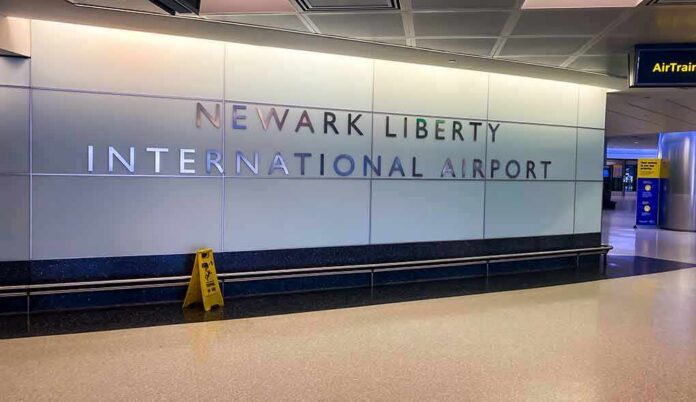
A Dutch social media star was taken into United States immigration custody at Newark Airport and moved to a private detention center, with officials offering no public explanation so far.
Story Highlights
- Multiple outlets report Vera Dijkmans was detained by U.S. Immigration and Customs Enforcement at Newark Liberty International Airport.
- Family says she is being held at Delaney Hall Detention Center in New Jersey, run by a private contractor.
- Government agencies have not publicly stated the legal reason for her detention.
- The case highlights airport screening power and private detention’s role in immigration enforcement.
What Happened at Newark and Where She Is Now
Dutch influencer Vera Dijkmans was taken into custody by United States Immigration and Customs Enforcement after arriving at Newark Liberty International Airport on November 11, according to multiple reports that cite family statements and news outlets in the Netherlands and the United States. Her family and friends later said she was transferred to Delaney Hall Detention Center in New Jersey, where she remains, according to a social media update reproduced by news sites. Reports describe the arrest as occurring after a flight from Miami to Newark.
Relatives have shared details about her treatment and the sudden nature of the detention. Her mother told a Dutch broadcaster that officers took her daughter without letting her bring personal items, such as a toothbrush. Several outlets repeated the family’s claim that Dijkmans cried while describing conditions in custody. Those details come from family accounts and reposts of their messages, not from official facility records or agency statements.
Facility, Contractor, and Immigration Process Basics
Delaney Hall is described in Dutch reporting as an immigration detention facility operated by the private company GEO Group under a long-term contract with United States Immigration and Customs Enforcement that began in 2025 and can hold up to 1,000 people. Private operators play a large role in immigration detention across the country. Federal research explains that the Department of Homeland Security relies on detention both during removal cases and after some final orders, with the agency controlling custody decisions in many categories.
Airport cases often fall under a legal idea known as the “entry fiction.” That doctrine allows the government to treat some arriving travelers as not yet admitted while screening is pending. Courts have held that during this phase, rights can be narrower than after full admission. A federal court resource notes that until formal proceedings begin with a Notice to Appear, officers are not required to advise of a right to counsel under the cited regulation. This helps explain why airport detentions can move quickly.
What Is Known and Not Yet Public
Several reports say United States Immigration and Customs Enforcement has not publicly stated the legal basis for Dijkmans’s detention, and her name does not appear in a public detainee database checked by reporters. Dutch media also reported that the reason for the apprehension was unclear, even as family members suggested possible paperwork or court issues. Those claims were not backed by records in the articles, and news outlets did not cite an official case number.
News reports vary on the purpose of her travel, mentioning combat sports events and influencer work tied to Miami and Newark. These differences do not change the central timeline: a detention at Newark and transfer to Delaney Hall. Family statements have driven much of the public detail on her conditions. Neither United States Immigration and Customs Enforcement nor GEO Group was quoted responding to those claims in the cited articles, leaving outside verification for later reporting.
Why This Case Resonates Across the Aisle
The story taps broad concerns about how power is used at the border, how private firms profit in immigration detention, and how quickly government can move a person into custody with few public details. Conservatives often stress the need for firm border control and clear rules. Liberals often raise fairness, humane treatment, and transparency. Both sides worry that large systems serve insiders first and leave regular people in the dark.
‘World’s most wanted’ OnlyFans model with 6m followers is arrested by ICE & cries over ‘unsanitary’ lockup conditions.
Dutch influencer and OnlyFans model Vera Dijkmans, who was arrested five days ago by US ICE agents, remains in custody without any reason given for her… pic.twitter.com/yT71EqLROj
— 7happy (@Sevenhappy007) November 17, 2026
Federal research shows that immigration detention rules give the government wide control at key moments in a case, including at airports and during removal proceedings. When private facilities are involved, people also ask who is accountable for safety, medical care, and daily living standards. These are not abstract issues. They affect real lives, and they shape trust in the system. Clear facts from authorities would help the public judge this situation on the merits.
Sources:
linkedin.com, news.com.au, rawstory.com, nltimes.nl, yahoo.com, dutchreview.com, congress.gov
© theredwire.com 2026. All rights reserved.