
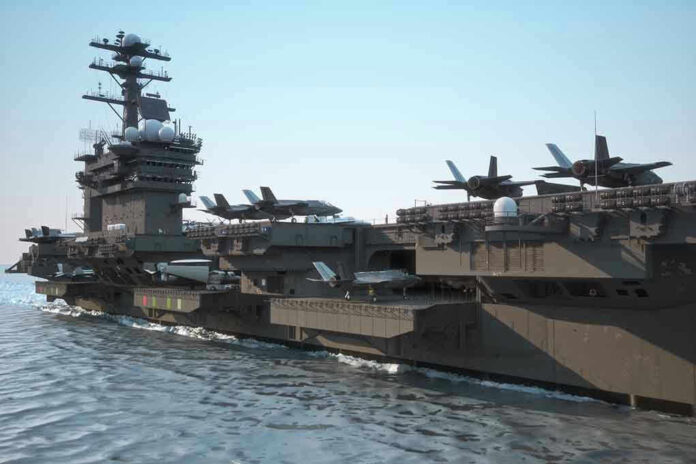
Aboard a critical U.S. Navy warship off Okinawa, a fire lasting over 11 hours has raised urgent questions about military readiness and the security of America’s forward-deployed forces under a renewed focus on national defense.
Story Highlights
- USS New Orleans suffered a serious fire near Okinawa, requiring multinational response and highlighting operational risks.
- Two U.S. sailors sustained minor injuries; cause of the fire remains under investigation.
- The incident underscores the strategic importance of the Western Pacific and the U.S.-Japan alliance.
- Recent events prompt reevaluation of shipboard safety, emergency protocols, and regional military posture.
Fire Erupts on USS New Orleans: Timeline and Response
On August 20, 2025, the USS New Orleans, a San Antonio-class amphibious transport dock, caught fire while anchored near White Beach Naval Facility off Okinawa, Japan. The blaze began between 4 and 5 p.m. local time and persisted for over 11 hours. U.S. Navy personnel, joined by the Japan Coast Guard and Japan Maritime Self-Defense Force, fought the fire through the night, finally extinguishing it at 4 a.m. the next morning. Two sailors sustained minor injuries and received immediate onboard treatment. The cause is still under investigation, with early reports indicating an electrical panel near the bow may have been involved.
This event comes at a time of heightened U.S.-Japan security cooperation and regional tension in the Indo-Pacific. The USS New Orleans, homeported in Sasebo and part of the U.S. 7th Fleet, was not underway but anchored, which influenced both the firefighting approach and the level of risk to its crew. Notably, no Marines were aboard at the time. The ship remains anchored as damage assessments and investigations continue, with the option for additional berthing provided by nearby allied vessels.
Operational Risks and Strategic Implications
The fire on the USS New Orleans is not an isolated incident. The U.S. Navy has faced several high-profile shipboard fires in recent years, including the catastrophic 2020 blaze on the USS Bonhomme Richard, which led to the ship’s decommissioning. Shipboard fires, though rare, pose severe operational and strategic risks, especially in forward-deployed fleets. Such incidents immediately impact the Navy’s ability to project power and maintain readiness in regions where American interests face constant challenge. The swift, coordinated response between U.S. and Japanese forces demonstrated the resilience of the U.S.-Japan alliance and the value of multinational preparedness in crisis situations.
In the aftermath, the USS New Orleans’ temporary loss of operational capability has prompted a fleet-wide review of fire prevention and response protocols. Experts warn that even minor injuries and limited damage can mask deeper vulnerabilities in maintenance standards, crew training, or equipment reliability. For a conservative audience concerned with military strength and global security, this incident is a vivid reminder that America’s adversaries watch for any sign of weakness among its forward-deployed assets.
Impact on U.S. Navy and Regional Security
Short-term, the focus remains on crew recovery, damage assessment, and restoring the ship to full operational status. Long-term, the Navy may face months of repairs and procedural changes, affecting not just the USS New Orleans but allied force posture throughout the Western Pacific. The cost of repairs, potential operational delays, and the need for comprehensive safety reviews all place additional strain on defense resources. Yet, the absence of fatalities and the containment of the fire without civilian impact are testaments to the professionalism of U.S. and allied forces.
Politically, this incident reinforces the strategic necessity of a robust U.S.-Japan partnership and highlights the critical role of host-nation support agreements in ensuring American military effectiveness abroad. It also intensifies scrutiny of defense readiness and budget priorities, especially as the administration seeks to reverse years of perceived neglect, globalism, and underinvestment in military infrastructure.
2 Sailors Injured in Fire on US Warship in Japan https://t.co/UCQtiwnKHX
— Jennifer flowersiFBAP (@bamato383) August 21, 2025
Broader implications extend to the entire U.S. Navy and allied fleets. Maritime analysts and naval historians point to the need for continual improvement in fire prevention, maintenance, and emergency response training. Any erosion of these standards not only endangers American lives but risks undermining the country’s ability to deter adversaries and defend constitutional values on the world stage. As investigations proceed, many will be watching to see whether lessons are learned and reforms implemented, ensuring that American power remains unchallenged and its defenders protected wherever they serve.
Sources:
Amphibious Warship USS New Orleans Catches Fire Off the Coast of Japan
Fire extinguished aboard USS New Orleans
Fire Aboard USS New Orleans Extinguished