

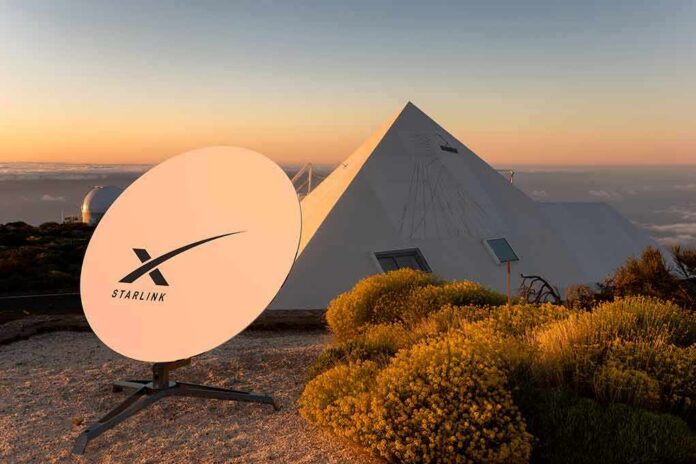
Elon Musk’s SpaceX wants federal permission to launch one million satellites that would turn low Earth orbit into a giant AI data center — and the government is actually considering it.
Quick Take
- SpaceX filed a Federal Communications Commission (FCC) application seeking approval for up to one million solar-powered satellites built for AI computing, not internet service.
- The plan relies on Starship rockets and Starlink-style hardware, with pilot tests of orbital computer chips set for later this year.
- Engineers warn that cooling the satellites and shielding computer chips from radiation are problems nobody has solved at this scale.
- Even SpaceX’s own investor filing admits the project “may not achieve commercial viability”.
What SpaceX Actually Asked The Government For
SpaceX filed application SAT-LOA-20260108-00016 on January 30, 2026, asking the FCC to approve up to one million satellites flying between 500 and 2,000 kilometers up. The company says it will use its Starship rocket to launch the first batches. Later this year, SpaceX plans to test AI computer chips riding on regular Starlink V3 satellites, a trial run before committing to specialized hardware.
The proposed satellite, nicknamed “AI Sat Mini,” would carry 100 kilowatts of power just to run AI processors, according to hardware details SpaceX released in March. Each satellite is designed to last about five years before it burns up on purpose, a safety plan meant to stop space junk from piling up. It’s a huge bet built on Starlink’s existing playbook of laser-linked satellites talking to each other in orbit.
Why Engineers Say The Numbers Don’t Add Up Yet
Computer chips like Nvidia’s, the kind that power most AI today, were never built to survive space radiation. Every 90-minute orbit exposes them to particles that flip bits and scramble data, and nobody has proven that software fixes can catch every error at massive scale. SpaceX has floated a radiation-hardened chip called “Tera F,” but as of this writing, it doesn’t exist yet.
Heat is the other giant hurdle. The AI-1 satellite design needs to dump more than twice the heat the International Space Station handles, using a radiator about a quarter of the size. No spacecraft has ever pulled that off. Research firm Gartner estimates orbital data centers could cost nearly three times what the same computing power costs on the ground, a gap that undercuts SpaceX’s pitch that space is actually cheaper.
SpaceX’s Own Paperwork Raises Doubts
Here’s the part that should give every investor pause: SpaceX’s confidential pre-IPO filing states its orbital AI plans “involve significant technical complexity and unproven technologies, and may not achieve commercial viability”. That’s the company’s own lawyers writing the warning label, not a rival trying to score points. When a business tells regulators and shareholders in writing that its flagship idea might not work, common sense says take the hype with a grain of salt.
OpenAI’s Sam Altman has publicly called orbital data centers economically unworkable this decade, citing launch costs and the near impossibility of sending a repair crew. Deutsche Bank analysts reportedly see cost parity with ground-based data centers arriving well into the 2030s, not the two-to-three-year timeline Musk has floated. Independent estimates peg total project costs in the trillions of dollars.
What Happens Next And Why It Matters
The FCC opened the application for public comment, with critics calling the plan “pie-in-the-sky” while the agency itself says feasibility is unclear at this stage. Analysts at CFRA and Morningstar have already slapped sell ratings on SpaceX’s newly public stock, warning that sky-high valuations are riding on an unproven AI bet. Meanwhile, Nvidia, Microsoft and Google are quietly working their own angles on space-based and AI computing, adding competitive pressure.
None of this means the idea is dead. SpaceX has a track record of beating skeptics on reusable rockets, and the FCC filing itself admits the million-satellite figure is a ceiling, not a promise, giving the company room to scale up only if the technology and economics actually work. Taxpayers and investors alike deserve straight answers on thermal testing, chip durability and real launch costs before Washington hands out approval for a project this size. Bold vision is good. Verified engineering is better.
Sources:
pjmedia.com, satnews.com, introl.com, reuters.com, theregister.com, linkedin.com, geekwire.com
© theredwire.com 2026. All rights reserved.