
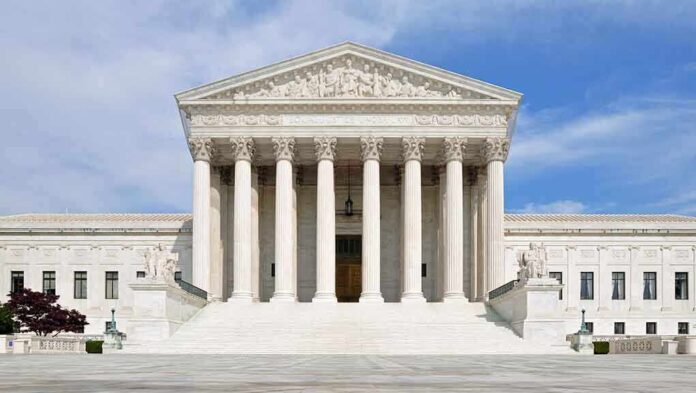
A pivotal legal battle threatens to redefine presidential power over trade policies, putting Chief Justice Roberts in the spotlight.
Story Highlights
- Supreme Court deliberates the scope of presidential authority in imposing tariffs.
- Chief Justice Roberts’ role is crucial in balancing constitutional limits.
- The decision could reshape executive power and trade policy for future administrations.
- Businesses and international partners await the ruling’s economic implications.
The Case at Hand: Learning Resources v. Trump
The U.S. Supreme Court is currently deliberating a case that could reshape the limits of presidential authority in trade matters. The case, Learning Resources v. Trump, questions whether former President Trump exceeded his powers by enacting broad tariffs under the guise of national security. The decision, expected in 2026, could redefine executive power and set a precedent for future administrations.
Historical Context of Section 232
Section 232 of the Trade Expansion Act of 1962 has historically allowed presidents to impose tariffs for national security reasons. However, it was rarely challenged until Trump’s aggressive application in 2018, which led to global trade tensions and retaliatory measures. This case tests the boundaries of this decades-old law, placing Chief Justice Roberts at the forefront of a major constitutional debate.
Impact and Implications
The Supreme Court’s decision will have significant implications. In the short term, businesses affected by the tariffs face uncertainty and potential economic impact. In the long term, the ruling could redefine the balance of power between Congress and the president, impacting how future administrations approach trade policy. The ruling will have broad economic, social, and political consequences, affecting everything from supply chains to presidential campaigns.
The implications of this decision are far-reaching. U.S. manufacturers, importers, and exporters, along with international trading partners, await the outcome. The decision not only impacts the economy but also the broader question of how much power a president should wield in matters of national security and trade. The Supreme Court’s ruling will be a defining moment in U.S. trade policy, with Chief Justice Roberts playing a pivotal role in shaping its outcome.
Sources:
POLITICO, November 5, 2025: Supreme Court oral arguments coverage
Supreme Court of the United States, Oral Argument Transcript, Case 24-1287