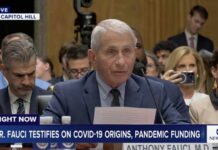

Senator Rand Paul told a Senate hearing that Bill Gates held a Department of Energy security clearance from 2014 to 2021, and he put a DOE letter into the official record to back it up.
Story Snapshot
- Senator Rand Paul says Bill Gates held a “Q clearance” from the Department of Energy for seven years.
- Paul entered a DOE letter into the Senate record during questioning about the origins of COVID-19.
- Q clearance gives access to some of the most sensitive nuclear and national security secrets in government.
- The claim surfaced during the same hearings where Paul subpoenaed Dr. Anthony Fauci over pandemic origin claims.
What Paul Told The Senate
Rand Paul, the Kentucky Republican who chairs the relevant Senate committee, made the claim during a hearing tied to his ongoing push for answers on the coronavirus pandemic’s origins. He said Bill Gates, the Microsoft co-founder and philanthropist, held a Department of Energy security clearance called a Q clearance between 2014 and 2021. Paul backed the claim by entering a DOE letter into the hearing record.
The hearing came as Paul pressed for testimony from Dr. Anthony Fauci, whom he had already subpoenaed over accusations Fauci misled Congress and the public about how the pandemic started. Gates was not the main subject of that hearing, but his name came up as Paul dug into who had access to sensitive government information tied to pandemic research and public health decisions.
Why A Q Clearance Matters
A Q clearance is not a minor credential. The Department of Energy requires it for anyone who needs to see Top Secret Restricted Data, Formerly Restricted Data, or National Security Information. It ranks alongside the highest security clearances in the federal government, and people who hold it can view details about nuclear weapons design and other closely guarded secrets.
That is what makes Paul’s claim notable. Bill Gates has never worked as a federal employee or held elected office. If he truly held a Q clearance for seven years, it would mean the Department of Energy gave a private citizen and tech billionaire access to some of the government’s most protected material, raising real questions about how and why that happened.
Broader Pattern Of Access Questions
This is not the first time claims about clearances, waivers, or special government access have exploded into bigger political fights. Because these records are often hard for outside observers to check quickly, a single phrase like “security clearance” can spark intense speculation before the full paperwork becomes public. That gap between what is documented and what is assumed fuels distrust on both sides of the aisle.
Congress has tried to tighten oversight of who gets access to sensitive facilities and information. A bill introduced this year, the GATE Act, would bar certain foreign nationals from visiting or working at National Laboratories, showing lawmakers already worry about who gets let into the government’s most sensitive spaces.
Gates’s Public Record On Government Ties
Bill Gates has faced scrutiny before over his connections to powerful institutions and controversial figures. He told Congress last year that meeting the late sex offender Jeffrey Epstein was a “grave error in judgment,” and he said in a written statement that he did not know about Epstein’s crimes at the time. Gates has also given sworn testimony in other legal proceedings, including a Justice Department antitrust deposition.
Gates has said publicly that his main focus now is giving away nearly all his wealth through the Gates Foundation over the next two decades, with the foundation set to close in 2045. None of that public record directly confirms or denies the Q clearance claim, but it shows Gates has long operated close to government circles, even without holding office himself.
What Remains Unconfirmed
Paul’s claim rests on the DOE letter he introduced at the hearing, and as of this reporting, the Department of Energy has not issued its own public statement confirming or denying the letter’s contents. That is a standard gap that often exists right after a document enters a hearing record, and it does not by itself cast doubt on what Paul presented.
Paul has a track record of pushing for stricter oversight into pandemic-era decisions, including his call for a Justice Department inspector general investigation into researchers Peter Daszak and Ralph Baric over their ties to federal agencies. The Gates clearance claim fits into that same broader effort to trace who had access to what information during the pandemic response.
Did you guys catch this little hand-off to the model behind Rand Paul just as he's speaking about the letter received by the DOE confirming Q Clearance was given to Bill Gates from 2014-2021 under Dr. Fauci's tenure @NIH?
What does that look like to ya'll, huh?
Is that? Is that… pic.twitter.com/7cRU4P6jBB
— Bria_Dear (@Bria_Dear1992) July 29, 2026
For voters already skeptical of unelected influence in Washington, the claim taps into a familiar worry: that wealthy, connected private citizens can gain access to government secrets without the same accountability elected officials face. Whether the full picture backs up Paul’s account will likely depend on further documentation from the Department of Energy.
Sources:
congress.gov, en.wikipedia.org, pbs.org, nypost.com, paul.senate.gov, fox9.com, justice.gov
© theredwire.com 2026. All rights reserved.