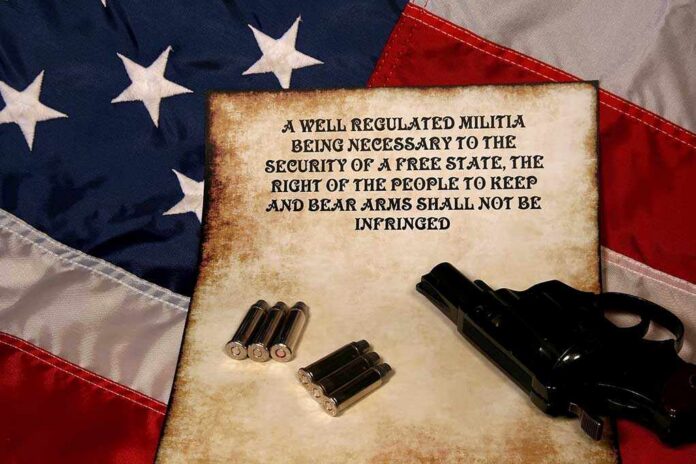
On the very day we celebrate liberty, activists pressed lawmakers to narrow a constitutional right.
Story Snapshot
- Advocacy groups used Independence Day to push tighter gun laws as “patriotic duty.”
- Supreme Court precedent protects an individual right, yet leaves room for some regulations.
- Lower courts have upheld certain bans and safety rules since Heller, though the field keeps shifting.
- The American Civil Liberties Union supports regulations tied to public safety, not blanket bans.
Patriotism, Pressure, and the July 4 Playbook
Advocacy groups often use July 4 to argue that gun safety is part of American freedom, not a threat to it. Moms Demand Action has staged outreach tied to parades, highlighting universal background checks and limits on certain semi-automatic firearms. This is not a one-off stunt but a recurring calendar move. The message lands on a day when symbols do heavy lifting, and it aims to fuse civic pride with legislative urgency. Skeptics hear culture war. Supporters hear common sense.
Claims that a specific Independence Day “campaign” stripped to names, dates, and documents are thin in the provided record. The pattern is clear, but the dossier lacks a dated press release from a named group for this year’s push. That gap matters for precise attribution. Still, the broader tactic is well documented over the past decade. The holiday offers a loud stage and a unifying script: protect kids, honor history, and pass laws. The script repeats because it works.
What the Supreme Court Actually Protects
The Supreme Court’s District of Columbia v. Heller decision said the Second Amendment protects an individual right to keep and bear arms for lawful purposes like self-defense. McDonald v. Chicago extended that right to the states. These rulings are now base law, not internet rumor. At the same time, Heller signaled that some long-accepted regulations can stand. That nuance gets lost in slogans, but it defines every legal fight that follows.
New York State Rifle and Pistol Association v. Bruen added a history-and-tradition test. Lawmakers now must show a rule fits with America’s historical approach to arms. That rule has made it harder to defend modern restrictions that lack clear roots. It also pushed courts to dig deep into old statutes and practices. The result is a live map, not a fixed one. Some rules fail under Bruen. Others survive when strong analogues exist.
The Gun-Safety Lane: What Survives, What Slips
Gun-control advocates argue that strong, targeted rules fit with the Second Amendment and save lives. Groups cite a long list of laws that courts have upheld since Heller. These include safe storage, extreme risk orders, and limits on certain weapons or magazine sizes in some circuits. They also point to the Founders’ acceptance of reasonable regulation to keep the peace. The case is not that “rights end,” but that rights come with boundaries to protect the public.
The American Civil Liberties Union backs regulation that ties to real public safety goals. The group frames this as consistent with constitutional limits and deference to legislatures. That stance rejects sweeping bans but supports measures with evidence and narrow scope. It seeks to square liberty with order. That is a classic American balance, even if the edges are sharp. Lawmakers who ignore that balance risk both court losses and public backlash.
Where Conservatives Draw the Line
Conservatives see July 4 calls for sweeping bans as a red flag. The individual right stands on firm Supreme Court ground. Requests to erase common firearms or block ordinary citizens from self-defense will run into that wall. Policy that punishes the law-abiding for crimes they did not commit offends both fairness and the text. Better targets include criminals, straw buyers, and those judged dangerous by a court with due process. That path is both moral and legal.
Common sense says focus on what works and what courts will uphold. Enforce existing laws against felons with guns. Fund data-driven policing that tracks the few who drive most violence. Support extreme risk orders with strict due process. Promote real safe storage without turning parents into felons over technical slips. These steps respect the right and the duty. They also match the Supreme Court’s framework far better than broad bans ever will.
Sources:
constitutioncenter.org, giffords.org, youtube.com, pmc.ncbi.nlm.nih.gov, shontelbrown.house.gov
© theredwire.com 2026. All rights reserved.