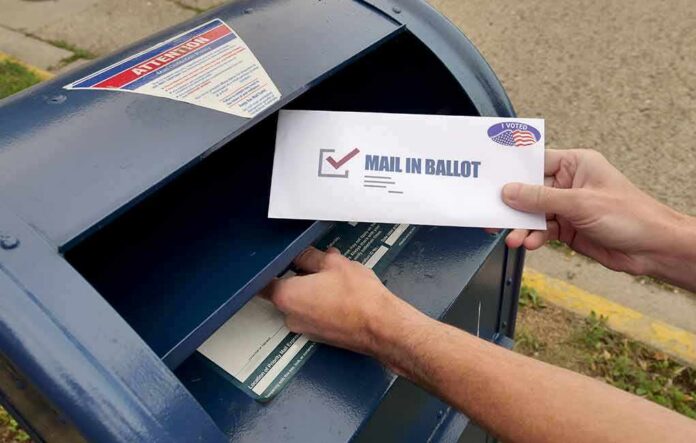
Federal prosecutors say a Utah mail carrier dumped more than 300 primary ballots in a dumpster, and they have the indictment to prove it.
Story Snapshot
- Justice Department unsealed an indictment alleging a carrier trashed about 300 Utah primary ballots.
- Investigators say the ballots were separated early in the shift and none were delivered.
- The defendant told investigators he acted out of “laziness,” not politics, according to reports.
- Postal inspectors and election officials cite strong safeguards, but rare failures still happen.
What the indictment says happened
The Department of Justice announced charges against a former United States Postal Service carrier accused of throwing away mail, including roughly 300 ballots addressed to registered voters ahead of Utah’s June primary. Prosecutors say the worker separated the ballots from other mail shortly after starting his route and did not deliver any of them. A federal grand jury returned one count tied to unlawful destruction and delay of mail. An indictment is an allegation; the defendant has entered a not guilty plea in court filings covered by local outlets.
United States Attorney Melissa Holyoak framed the case as a breach of trust that also deprived citizens of their right to receive election mail, according to the government announcement. The charging document centers on the handling of election mail, which the Postal Service classifies and tracks with special procedures. The claim that none of the set-aside ballots reached voters raises stakes beyond a routine delivery delay and moves the matter into alleged criminal conduct with civic impact.
What the defendant says about motive
News reports based on interviews and court documents say the carrier told investigators he had no political agenda. He said he felt overwhelmed by the volume and acted out of laziness to lighten his workload. CBS News reported that prosecutors said he set the ballots aside within about 90 minutes of starting his shift, which undercuts the idea this was a late-day judgment error. His stated motive, if accurate, points to a personal failure, not an organized plot. That still challenges public trust because results rely on every link in the chain working.
Claims of “no political motive” deserve clear, narrow treatment. The government has not charged an election fraud conspiracy. The charge targets destruction and delay of mail. That fits conservative common sense: motive can matter at sentencing, but duty comes first. People count on the mail carrier to deliver every piece, especially ballots. Personal shortcuts are not an excuse when the job is to protect a core public service. Courts will sort intent; the law forbids the act either way.
How often this happens and what protects voters
Postal Service oversight data shows election and political mail moves on time at very high rates, with on-time processing in recent primaries around 98 percent. The Postal Service Inspector General highlights strict intake checks for large ballot mailings and active pursuit of mishandling allegations. That is why local complaints triggered an inquiry and why inspectors traced the missing ballots. The system is designed to spot outliers fast. Most ballots arrive; rare failures still require a stiff response to deter repeats.
Mail voting depends on a simple promise: the ballot sent to a voter will actually reach the voter.
Federal prosecutors say former Utah postal worker Damon Matai Seei threw away mail assigned for delivery on June 3, including about 300 ballots for Eagle Mountain residents before… pic.twitter.com/fMPD58nZJF
— Dan Holbrook (@DanHolbrook) September 23, 2026
Election safeguards add further layers outside the mail stream. Local clerks track who received ballots and who returned them. Signature checks, bipartisan review boards, and public canvass meetings create backstops when mail goes missing. That is the practical answer to loud claims that any mail failure means the sky is falling. The better read is simpler: mail voting works well at scale, and when one link breaks, investigators and prosecutors step in so voters do not pay the price.
Accountability without melodrama
The clean lesson is not that mail voting is doomed; it is that people need consequences when they break rules that guard civic trust. The Justice Department brought a targeted charge tied to the act alleged, not political theater. Voters deserve that clarity. Conservatives who want secure elections and liberals who want access can agree on this much: deliver every ballot, punish those who do not, and keep the safeguards visible so citizens see the system correcting itself in real time.
Sources:
cbsnews.com, foxnews.com, washingtonexaminer.com, lawcommentary.com
© theredwire.com 2026. All rights reserved.