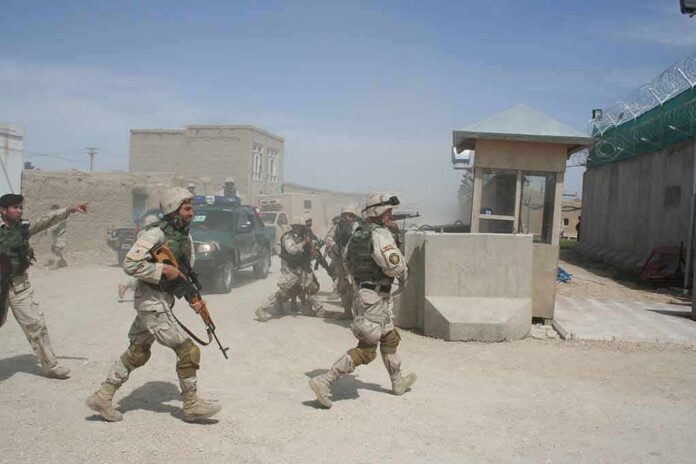
Iran’s army chief publicly offered $30,000 for any American soldier killed or captured during a U.S. attack on Iranian soil, escalating a dangerous war-time incentive.
Story Snapshot
- Iran’s Major General Amir Hatami announced a $30,000 reward, doubled for women, tied to a U.S. invasion scenario.
- Reports say the reward would rely on public or private contributions, not a formal state budget line.
- The statement adds pressure amid broader Iran–U.S. brinkmanship across the region.
- Operational details on how claims would be paid have not been provided in reports.
What Iran’s Bounty Offer Says and When It Applies
Multiple outlets reported that Iran’s army chief, Major General Amir Hatami, said Iranians would receive about $30,000 for killing or capturing a U.S. soldier who invades Iran, with the reward doubled for women. Coverage described this as a public statement made at a Journalists’ Day event. Reports stressed the condition: the bounty applies only if U.S. troops attack Iranian territory, not in general or worldwide. This framing presents the offer as a deterrent during a potential ground conflict.
Reports differed slightly on the funding source. One said the money would come from public contributions. Another said private contributions would fund it. None of the reports detailed a formal decree, payment office, or verification method for claims. Outlets did not cite any paid rewards or proof of program setup. That leaves the announcement as a stated incentive, not an observed payout system. Still, the clear, on-the-record wording marks a sharp escalation in rhetoric.
How This Fits Iran–U.S. Pressure Tactics
This offer matches a pattern where Iran uses public threats and incentives to raise costs for the United States without declaring war. Analysts say Iran’s strategy blends missiles, drones, naval harassment, and information campaigns to shift risk for U.S. forces and partners. By naming a cash amount and tying it to an invasion scenario, Tehran signals that any ground push could face direct, incentivized resistance. That message matters even if the reward is hard to administer in practice.
Regional reporting describes Iran widening pressure points to influence Washington’s choices. These include risks to shipping lanes, cross-border strikes, and asymmetric tools that blur lines between military and political moves. The bounty offer adds a human cost warning to that mix. It tells U.S. leaders, troops, and families that ground operations could trigger person-by-person incentives on the battlefield. That raises fear and complicates planning, which is often the point of such messaging.
Why Americans Across the Spectrum Care
Families with loved ones in uniform see a direct threat. A price on a soldier’s head, even under invasion conditions, feels like a red line. Americans who favor strong deterrence view this as hostile incitement that must be met with resolve. Others, angry at years of war and political gridlock at home, see another sign that leaders allowed tensions to spiral while basic needs went unmet. Both reactions reflect a common worry: the system is not protecting ordinary people.
Iran Offers $30,000 Bounty for Killing, Capturing US Soldiers https://t.co/gUiTtCFYVL
— CJWARNER (@CJWARNER19) August 16, 2026
For voters tired of posturing, the key test is what comes next. Clear rules, steady diplomacy, and honest risk management can reduce missteps. Commanders can harden bases and brief troops on capture risks. Lawmakers can demand practical goals and timelines. The White House can push quiet channels to lower the temperature while preparing firm responses if troops are targeted. None of that fixes Washington’s deeper trust gap. But it helps keep Americans safer while leaders argue about strategy.
Sources:
redstate.com, yahoo.com, hamerintel.com, facebook.com
© theredwire.com 2026. All rights reserved.