
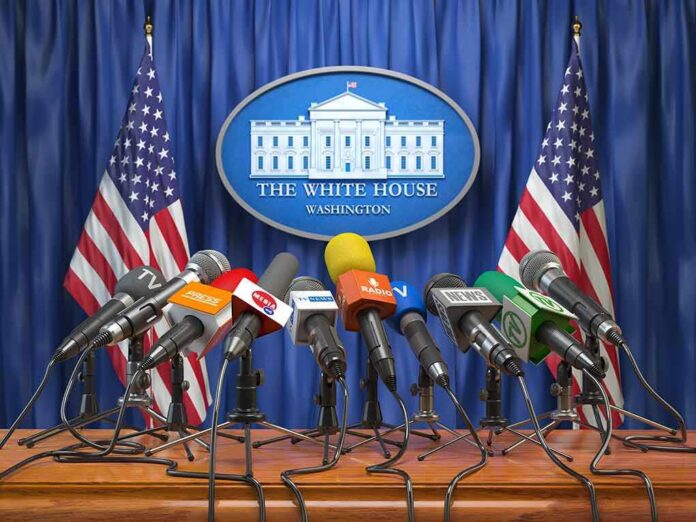
President Trump warned that news outlets that “print lies” will face lawsuits so sweeping “they’d really be finished,” as a court fight over his White House press ban intensifies.
Story Highlights
- Trump accused CNN, MS NOW, and Politico of publishing “fiction and lies,” and moved to block their White House access.
- A federal judge later said the ban likely violated free-speech and due-process rights and paused it while the case proceeds.
- Trump is also suing the BBC for $10 billion over a documentary he calls defamatory, pressing a broader deterrence strategy.
- The outlets frame the dispute as retaliation against protected reporting; they seek full restoration of credentials.
Trump’s Charge: False Reporting And A Promise To Sue
President Trump said CNN, MS NOW, and Politico pushed “fiction and lies” about him and his administration. He announced their exclusion from the White House on September 18, 2026, and warned other outlets could face the same fate. His message paired a public rebuke with a legal threat designed to deter what he calls false reporting. The court filings tie that decision to coverage he viewed as unfair, and to stopping future misinformation from reaching Americans.
Trump’s approach goes beyond press access. He also turned to defamation law to target what he says are deliberate falsehoods. In a separate case, he sued the British Broadcasting Corporation for $10 billion over a documentary he says painted a malicious and deceptive picture of him and aimed to sway the 2024 race. The complaint lays out legal theories and specific claims about the film’s content, signaling a push to litigate rather than just complain publicly.
The Court Pushback: First Amendment And Due Process
CNN, MS NOW, and Politico sued to restore access, arguing the government cannot pull credentials because it dislikes reporting. A federal judge agreed in part and blocked the ban while the case continues. The court found likely violations of free-speech and due-process rights. That ruling stresses that when the White House opens its doors to the press, it cannot shut them on the basis of viewpoint, even when coverage is tough or critical of the administration.
The judge’s order does not decide the full case, but it sets the ground rules. The White House must follow fair procedures and cannot retaliate against protected speech. That means the question of falsity is separate from the question of access. If reporting is actually false and damaging, the remedy is a lawsuit that tests facts under oath, not a swift lockout from the briefing room. The court’s message is clear: enforce standards, but do it by the Constitution.
What Is Proven, What Is Contested
Trump’s filings describe why he believes these outlets crossed clear lines. But the materials do not yet list specific articles and passages from CNN, MS NOW, or Politico that a court has found false. The BBC case also remains in litigation, with no final ruling on defamation. BBC lawyers sought to compel Trump’s deposition after a schedule change, underscoring that both sides still must answer questions under oath before any final judgment is reached.
The outlets say they report fairly and that the ban punished them for that reporting. They argue that leaving the credential revocations in place would chill watchdog journalism and reduce the public’s independent view into the federal government. The court’s temporary order supports their position for now. But a courtroom is also where claims of falsehood can be tested line by line, with documents, edits, notes, and sworn testimony on the record for the public to judge.
What It Means For Conservatives
Conservatives know the media often treats our values like a punchline. Many remember years of slanted coverage on borders, energy, faith, and guns. Trump’s message is simple: if you lie, expect a lawsuit that hurts. The courtroom is where proof matters, not headlines. That path protects both the Constitution and accountability. It keeps government from picking winners in the press room, while still holding powerful outlets to basic truth and fairness the country deserves.
What To Watch Next
Watch the access lawsuit for final rulings on process and viewpoint discrimination. Track discovery in the BBC case for documentary records, editing notes, and depositions that could prove intent and falsity. Look for any administration list that links specific stories to claimed errors. If those items surface, Americans will see whether this is tough reporting, partisan spin, or provable lies. That evidence will decide who pays—and whether the threat of ruinous suits becomes real.
Sources:
mediaite.com, cnbc.com, nytimes.com, nbcnews.com, courthousenews.com, washingtonexaminer.com
© theredwire.com 2026. All rights reserved.