
U.S. embassies across the Middle East issued near-identical security alerts warning Americans to brace for sudden escalation and travel disruptions.
Story Highlights
- Multiple U.S. embassies warned of a complex security environment with risk of unforeseen escalation.
- Alerts advised Americans to expect possible flight cancellations, airspace closures, and travel delays.
- Posts appeared across several countries, signaling a coordinated, region-wide message.
- Embassy social posts mirrored the same wording, reinforcing the shared guidance.
Embassies Issue Region-Wide Security Alerts
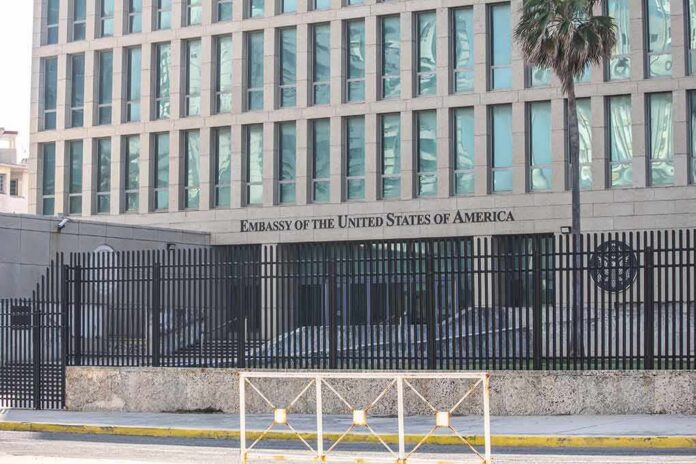
U.S. diplomatic missions in several Middle East capitals posted matching security alerts warning that tensions could escalate without warning. Notices in Jordan and the United Arab Emirates used the same core text, stating the security environment “remains complex with the potential for unforeseen escalation.” The alerts urged Americans to stay vigilant and prepare for possible travel disruptions, including flight cancellations and airspace closures. Embassy channels described the warnings as preventive steps amid fast-moving regional risks rather than a single-country issue.
News summaries said at least eleven U.S. embassies in the region shared similar guidance, highlighting a coordinated message to citizens across borders. Coverage listed posts in Israel, Saudi Arabia, Iraq, Kuwait, Lebanon, Jordan, Bahrain, the United Arab Emirates, and Qatar. That reach signals a State Department focus on regional conditions, not isolated events. The alerts aimed to help travelers plan, delay trips, or depart early if needed due to possible transportation limits.
What The Alerts Told Americans To Do
Embassy notices told Americans to exercise heightened vigilance and to watch for sudden changes in flights and border rules. The warnings said travelers should be ready for airspace closures and delays that could complicate exit plans. The U.S. Embassy in Amman posted the language on its website, while the U.S. Embassy in Abu Dhabi carried a similar alert on its site. Both emphasized situational awareness and flexible plans if routes close with little notice.
Embassy social media accounts echoed the same language to reach more people quickly. The U.S. Embassy in Qatar posted a Security Alert repeating the call for vigilance and warning about possible flight cancellations and travel disruptions. U.S. Embassy accounts in Beirut and Riyadh shared similar messages. The cross-posting matched a common State Department practice when risks rise across several countries at once.
Why The Government Uses Standard Wording
State Department and embassy alerts often use standard phrasing when the risk is broad and changing. Officials aim to warn citizens without sharing sensitive intelligence or naming targets that could tip off hostile groups. Standard text also speeds delivery across many posts at once. That helps Americans make choices early, like changing tickets, avoiding certain areas, or leaving before routes close. This approach has been used in other regional flare-ups as well.
The alerts did not point to a single named plot or a specific attack plan. Instead, they framed the risk as regional tension that could spill over quickly. Media tracking noted similar wording across multiple embassies, which supports the idea of a coordinated, region-wide caution. Embassy pages and official social posts serve as the primary sources for this guidance. Travelers in the region were told to monitor local media and embassy channels for updates and practical steps.
What It Means For Travelers And Families At Home
Americans in the Middle East may face last-minute flight cuts, rerouted paths, or closed airspace. That can strand travelers, raise prices, and slow aid or family travel. The alerts suggest building extra time into plans, keeping travel documents handy, and staying in touch with airlines and hotels. Families in the United States should check embassy pages to help loved ones abroad make quick choices. Official posts and alerts will update if risks rise or routes change again.
Why This Matters For Trust In Government
Many Americans on the left and right worry that Washington reacts late and speaks in code. These alerts show a faster, clearer push to inform citizens, even if details are limited. The plain takeaway is practical: be ready to move, and expect delays if tensions spike. That does not solve deeper problems, but it helps people act sooner. When the government shares timely, consistent warnings across embassies, it gives citizens a head start in a tough region.
Sources:
njsr.com.ng, yahoo.com, avapress.com, ground.news
© theredwire.com 2026. All rights reserved.