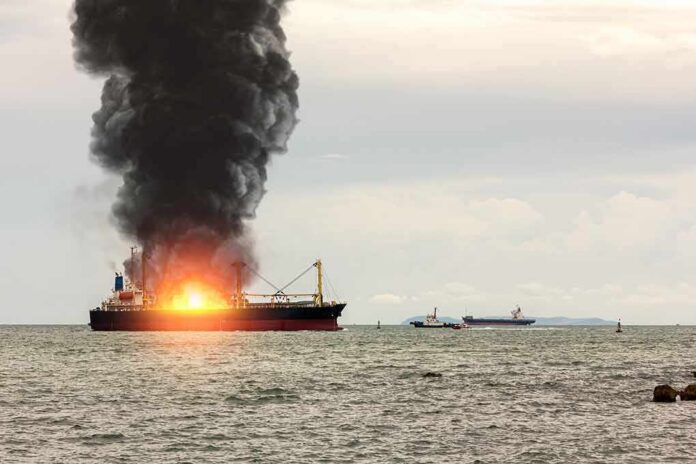
A small Indian cargo ship sinking off Yemen after a suspected attack is another warning that global trade — and ordinary workers — are caught in the crossfire of distant conflicts and detached elites.
Story Snapshot
- An Indian-flagged cargo vessel sank in the Red Sea off Yemen after an attack, but all crew survived.
- Indian officials say the ship was hit by a projectile, while Yemeni forces describe an explosives-laden boat.
- The incident fits a growing pattern of attacks on civilian shipping in the Red Sea and nearby waters.
- Governments condemn the strikes, yet the sea lanes that feed the global economy remain dangerous and unstable.
What happened to the Indian ship off Yemen?
India’s Ministry of External Affairs said an Indian-flagged commercial vessel named MSV Faize Noore Oliya sank in the Red Sea off the Yemeni coast after being attacked on August 4, 2026. The ministry stated that all 13 Indian nationals on board were rescued and that its embassy in Riyadh is working with Yemeni officials to keep the crew safe. Yemeni government forces said the ship was attacked about 13 nautical miles south of the port city of Hodeidah, in waters already tense from past strikes.
Yemeni authorities reported that an explosives-laden boat struck the vessel, causing it to capsize and sink, and they carried out a joint rescue using coast guard and naval units. Their statement said 14 people were on board — 13 Indian sailors and one Yemeni sailor — and all were taken to safety and given medical help, with no deaths reported. This matches broader reporting that the crew survived but highlights how dangerous the area has become for small traders and sailors just trying to earn a living.
How do official accounts describe the attack?
India’s shipping minister, Sarbananda Sonowal, said the cargo vessel was hit by a projectile near Yemeni waters, which caused it to overturn and sink. He wrote that “all 14 seafarers (including 13 Indians) have been safely rescued by the Yemeni Coast Guard and brought to the Port of Mokha,” and called the attack “unprovoked” against a defenseless sailing vessel. The Ministry of External Affairs condemned the strike and thanked Yemeni authorities, stressing that the safety of Indian crew members is a top priority for New Delhi.
Media reports pick up both strands of this story. Some outlets, repeating Indian officials, say the ship was hit by a missile or projectile. Others rely on Yemeni statements that point to an explosive boat, a tactic linked to Yemen’s Houthi forces in earlier Red Sea attacks. The Yemeni National Resistance Forces blamed the Houthi group for this strike, but the Houthis did not immediately comment, and there is no public forensic report yet tying a specific weapon to the wreck. That gap leaves room for doubt even as everyone agrees the ship was attacked and sunk.
Why does this matter for global shipping and ordinary people?
This sinking is not an isolated event. Recent years have seen repeated attacks on cargo ships in the Red Sea and nearby waters, often tied to wider fights that have nothing to do with the sailors on board. In one case, a Liberian-flagged ship was attacked and later sank, with several crew members dead or missing. In another, a different Indian-flagged wooden cargo vessel reportedly went down off Oman after a suspected drone or missile strike, again with 14 crew members rescued. These incidents show a pattern: commercial ships and working crews are being targeted or caught up in regional wars.
Each attack raises shipping insurance costs, disrupts routes, and pushes prices higher for fuel, food, and goods back home. That hurts families on tight budgets in the United States and around the world. It also feeds anger on both the left and right, who see global trade rules and foreign conflicts managed by distant elites while regular people take the risk and pay the bill. When a small livestock or cargo vessel from Gujarat or another coastal region is struck, it is not a billionaire’s yacht that sinks; it is a working ship crewed by ordinary men chasing their own version of the American Dream.
Unanswered questions and the “deep state” feeling
Key facts here are clear: the Indian-flagged ship was attacked, it sank off Yemen, and the crew survived. Still, basic details remain unsettled. Officials do not yet share full forensic data on the wreck. There is no public hull or blast analysis that proves whether a missile, drone, or explosive boat hit the vessel. No detailed ship owner’s report, voyage log, or satellite track has been released to explain exactly how the attack unfolded or who ordered it.
Just in: Indian Shipping minister Sarbananda Sonowal statement on sinking of Indian commercial vessel in Red Sea
"Indian MSV Faize Noore Oliya has been hit by a projectile near Yemeni waters, causing the vessel to capsize and sink. India strongly condemns this unprovoked attack…
— Sidhant Sibal (@sidhant) August 4, 2026
For many citizens, this is part of a larger story. Government ministries issue strong words, condemn attacks, and thank foreign partners. Yet the shipping lanes stay dangerous, and the same classes of global players — large states, armed groups, defense contractors, and insurance firms — continue to operate with little transparency. Conservatives and liberals alike see innocent workers and small traders exposed while officials seem more focused on statements than solutions. Incidents like the sinking of MSV Faize Noore Oliya reinforce a shared worry: the systems meant to protect commerce and human life on the high seas are failing, and the people in charge are not feeling the same risk as the crews they send into harm’s way.
Sources:
insiderpaper.com, siasat.com, x.com, ndtv.com, newsx.com, mea.gov.in, facebook.com, youtube.com, themedialine.org, moneycontrol.com
© theredwire.com 2026. All rights reserved.