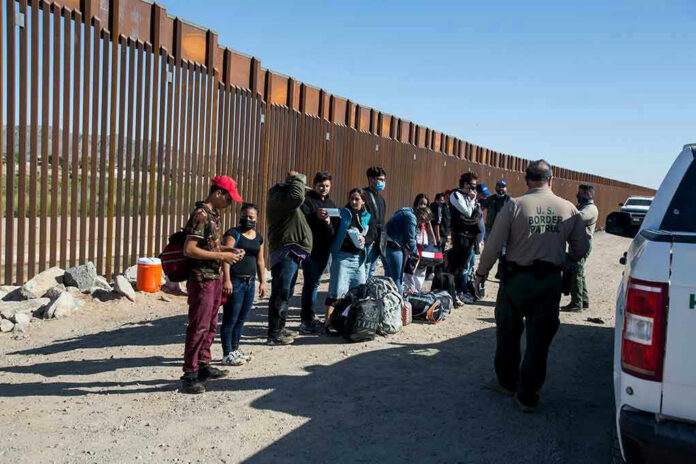
The Supreme Court just handed President Trump a major border win, ruling that migrants still standing in Mexico have not “arrived” in America for asylum purposes.[7]
Story Snapshot
- Supreme Court rules 6-3 that migrants on Mexican soil cannot claim U.S. asylum and may be turned away.[7]
- Justice Department lawyers argued “you can’t arrive in the United States while you’re still standing in Mexico,” and the Court agreed.[1]
- Decision revives and strengthens metering and turn-back practices at ports of entry, tightening border control.[6][7]
- Media and advocacy groups blast the ruling as harsh, but conservatives see a long-awaited defense of sovereignty and law.[7][8]
Supreme Court Redefines When Asylum Rights Begin
The Supreme Court’s 6-3 decision in Noem v. Al Otro Lado settles a key question that has dogged border policy for years: when do asylum rights start?[7] Federal immigration law says a foreign national “physically present” in the United States or who “arrives in” the country may apply for asylum.[1] For years, activists argued that simply walking up to a port of entry on the Mexican side counted as arrival. The Court has now backed the Trump administration’s narrower reading, tying asylum rights to actual entry onto U.S. soil.[6]
During oral arguments, Justice Department lawyer Vivek Suri summed up the government’s position in plain language that resonates with common sense.[1] He told the justices, “You can’t arrive in the United States while you’re still standing in Mexico … That should be the end of this case.”[1] The majority effectively agreed, rejecting earlier lower-court rulings that had treated border-side presentation as enough to trigger asylum protections.[6] This decision restores a clear line at the border and gives frontline officers a more workable rule.
Metering Policy Revived and Border Agents Get Clear Authority
The case centered on the long‑running “metering” and turn‑back practices at ports of entry along the southern border.[6] Under metering, officers limit how many people may cross and claim asylum on any given day, often directing others to wait in Mexico. A divided Ninth Circuit Court of Appeals had ruled that migrants approaching an official crossing were “arriving in” the United States and thus had the right to be processed.[6] The Supreme Court has now reversed that view, allowing immigration officers to turn away asylum seekers who remain on Mexican soil.[7]
For conservative readers worried about chaos at the border, this ruling matters in practical ways. The federal government argued that a broader idea of “arrival” would overwhelm border facilities and staff.[1] If every person who simply lines up at the gate counted as having arrived, agents would be forced to process massive numbers regardless of capacity.[1] By holding that asylum rights start only once someone is inside the country, the Court gives the Trump administration stronger tools to control flows, deter organized caravans, and protect communities along the border.[7]
Legal Fight Over “Arrival” and Ongoing Media Backlash
Critics point out that the asylum statute does not spell out what “arrive in” means, leaving room for argument.[1] Earlier district and appeals courts had accepted the claim that turning people away at ports of entry unlawfully denied them asylum access.[4][8] Human rights groups, including Amnesty International, now say the right to seek asylum at the U.S.-Mexico border is “non‑existent” and accuse the United States of violating international obligations.[10] Their focus is on humanitarian impact, not on the clear legal line the Supreme Court has now drawn.
Major media outlets frame the ruling as trapping migrants in a “permanent limbo” and describe the decision as a major setback for asylum rights.[8] They highlight crowded camps and harsh conditions on the Mexican side while rarely acknowledging the strain unchecked entry puts on U.S. towns, schools, and hospitals.[11] The 6-3 split on the Court is also used to paint the ruling as political rather than principled.[7] But the majority’s reasoning rests on a basic idea most Americans share: foreign nationals outside our borders do not have the same legal claims as those inside.
What This Border Win Means for Sovereignty and Security
For many conservatives, this decision is a long‑delayed correction after years of legal activism that blurred the border.[6] By confirming that migrants must first enter the United States to claim asylum under federal law, the Court reinforces national sovereignty and the meaning of territorial limits.[5] It strengthens President Trump’s broader effort to address what he has called an “invasion” at the southern border and backs policies that prioritize order over catch‑and‑release.[14] The ruling also undercuts lawsuits that aimed to force open ports of entry by redefining “arrival” through the courts rather than through Congress.[4]
The Supreme Court cleared the way Thursday for the Trump administration to potentially revive an immigration policy once used to turn back migrants seeking asylum at the U.S.-Mexico border. https://t.co/igpRVC7ub3
— KOKH FOX 25 (@OKCFOX) June 25, 2026
Many advocacy groups will keep fighting in court and in the media, pushing Congress to rewrite the law and attacking the administration for tightening border controls.[8] But for readers who value secure borders, limited government, and the rule of law, the Supreme Court has delivered a clear message: America decides who gets in, and standing on the other side of the line is not enough. The next key battle will be whether lawmakers try to undo this clarity or build on it with stronger, more precise immigration statutes.[9]
Sources:
[1] Web – Border Win: SCOTUS Rules Migrants in Mexico Haven’t ‘Arrived’ in the …
[4] Web – Supreme Court weighs if migrants stopped at US-Mexico …
[5] Web – Supreme Court to consider case that could limit asylum rights for …
[6] YouTube – Supreme Court weighs if migrants stopped at US Mexico border can still …
[7] YouTube – SCOTUS weighs if migrants stopped at US-Mexico border can still claim …
[8] Web – Supreme Court allows immigration officials to turn away asylum seekers …
[9] Web – ‘A Permanent Limbo State’: Migrants Are Running Out of Options After …
[10] Web – Supreme Court to decide if migrants turned away at border can seek …
[11] Web – The Right to seek asylum does not exist at U.S.-Mexico Border
[14] Web – Asylum in the United States – American Immigration Council
© theredwire.com 2026. All rights reserved.